Bits and Pieces
Burning Man, SantaCon, and protest aesthetics

I’m giving readers who are interested time to finish my “Notes from Nashville” — which, apologies, ended up being twice as long as the first installment of Great Expectations.
“Notes” describes the general state of free speech in 2025 (not good), but the bulk of the piece concerns one of the most controversial characters from the Twitter Files — Renée DiResta, a misinformation expert accused of censoring internet communications on behalf of the DHS, who’s now reinvented herself as a free speech pundit, for two years running, at Vanderbilt’s Global Free Speech Summit. “Something is rotten in the state of Denmark” (where, it so happens, the organizer of the GFS summit hails from). Read my full take here.
In the meantime, I’m linking to two outlandish pieces, one from the inimitable Sam Kriss, the other from Chuck Palahniuk, with a few notes on each. Plus, some supplemental viewing and reading material for those who are interested in where this is going.
The common thread, is Burning Man.
Sam Kriss, “Numb at Burning Man,” Numb at the Lodge.

How does Sam Kriss get from Leningrad to the Nevada desert? His repertoire is expansive. Read it and believe it.
I’ve recommended one of Kriss’ articles before, about Taylor Swift. Of course, being a Kriss piece, it was about a lot of other, more apocryphal and gnostic material besides the pop singer, but that’s vintage Kriss — hyper-intelligent, sublimely interesting, irreverent, fun. I can confidently recommend just about everything this guy has written, to a certain kind of reader, and all of it will make you smarter… or feel dumber. One of the few Substack writers I know whose pieces are as long as mine, except, you know, enthralling. An heir to the old New Journalism. In the piece above, somehow he begins in a 1930s Soviet utopian gulag, and winds up unmasking a bacchanal of millennial Silicon Valley autists in the Black Rock Desert.
The only element missing from Kriss’ account of Burning Man, you can read about below…
Chuck Palahniuk, “What Went Wrong With SantaCon?,” Vulture.
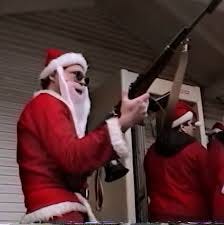
This — Kris Kringle with a deer rifle — is where Burning Man originated. Looks like my old house, in Portland.
A few months ago, I mentioned an intriguing local development. Chuck Palahniuk, author of Fight Club, was convening a monthly writer’s group several blocks from my home.
I attended one reading, as a lurker, to see what Palahniuk’s project looked like. A private residence, owned by a helpful accomplice, who hosts Palahniuk, an open bar, and about a dozen regular weirdos who convene in her converted garage once a moon, to cold-read everything from science fiction to flatulence fiction (one young hipster, who came across as more of a stand-up comic, shared an amusing story about her uncanny ability to throw fart noises across the room; she was moving to L.A, to pursue her dreams).
Slush Pile, as the event is known, is quintessential Portland. At the time, I noted that Palahniuk seemed to model his monthly open mic, loosely, on the setting of his bestselling novel — it led me to dub the gathering “Write Club.” Members of this literary version of Project Mayhem, for example, are often given a stated task for the week, and instructed to show up at an old house, a little nicer than the one in Fight Club, but no less DIY, to test their mettle against like-minded collaborators.
I revisited the film version of Chuck’s novel around this time, since the task that week was to watch Animal House and determine what the National Lampoons frat caper had in common with Palahniuk’s script about a run-down house full of socially-inept males living together under one roof. (Both boast a sex scene involving one yellow rubber glove.)
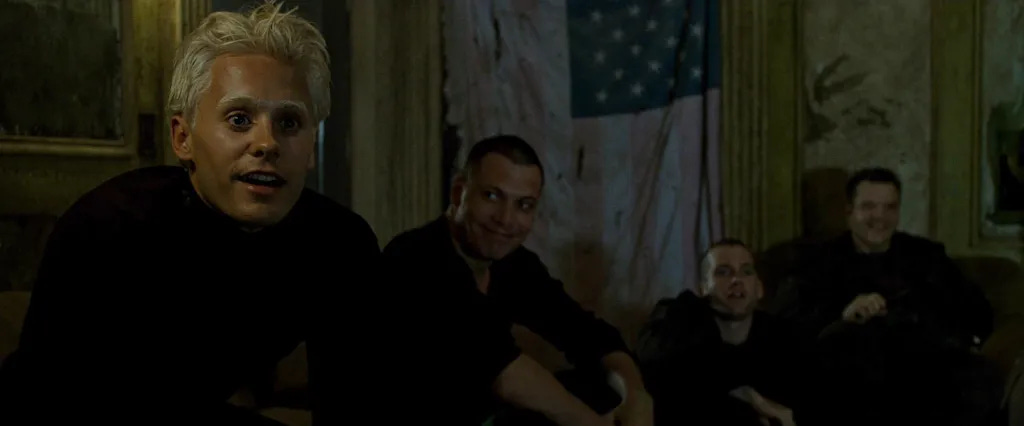
It occurred to me that I was watching Antifa porn. A bunch of guys in black bloc (one of them with large feminine breasts), creatively vandalizing and terrorizing an unnamed city for kicks, in the name of some vaguely anti-establishment cause. One of those nihilistic narratives you appreciate as a twenty-something, then wonder what was wrong with you when you revisit them twenty years later.
The similarities between Antifa and Fight Club’s Project Mayhem had been circling in the back of my mind for months, when Chuck announced he was publishing an article in Vulture about a related syndicate, which informed his conception of Project Mayhem: the Cacophony Society.
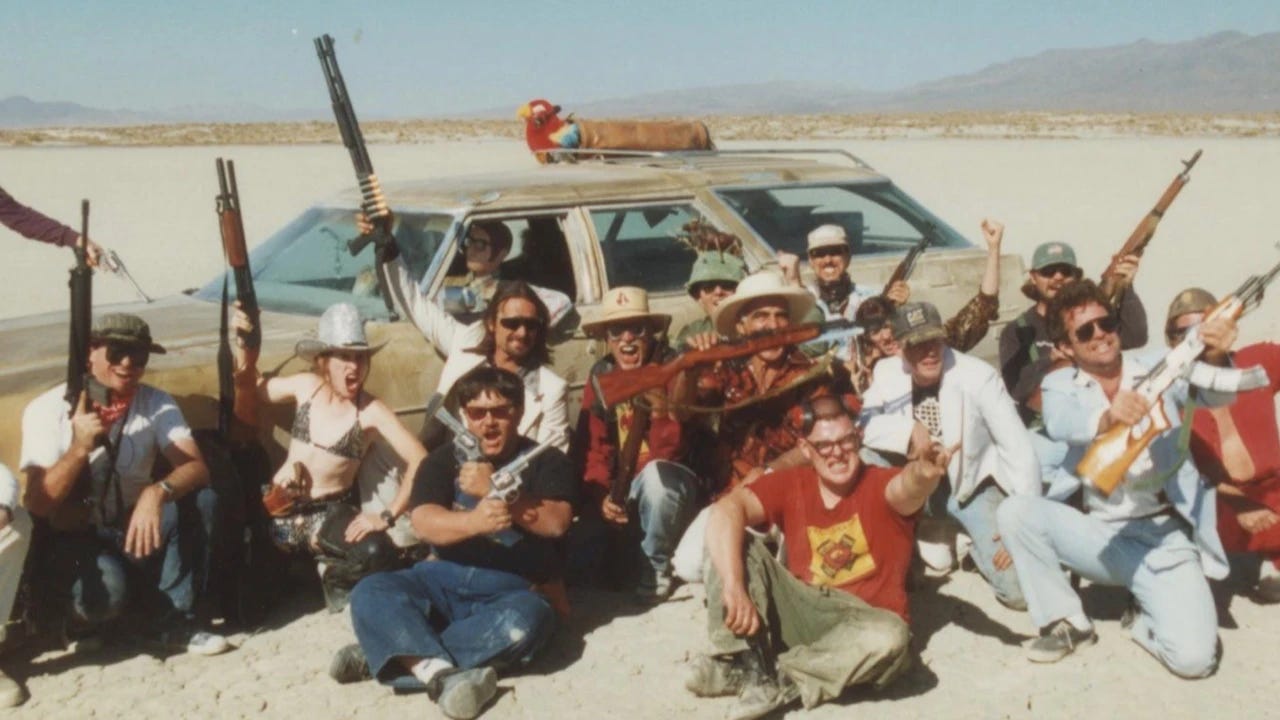
In some ways, the Cacophony Society has roots in 1960s countercultural “Happenings” — Be-Ins, Die-Ins, Love-Ins, The Acid Tests, etc. It, like these, was a product of the Bay Area.
A precursor group, the Suicide Club (named after a short story collection by California pilgrim Robert Louis Stevenson), staged events designed to take participants out of the realm of everyday experience, into what anthropologists deem “liminal spaces,” for the duration of the Happening. The original Suicide Club challenge, I’m told, in 1977, involved clinging to the sea wall beneath the Golden Gate Bridge during a winter storm, as ice cold breakers crashed over the founding members of the Suicide Club. When the Suicide Club disbanded, the Cacophony Society took up their torch.
One of the Cacophony Society’s hallmark stagings was the Santa Rampage (pictured up top), later incorporated as SantaCon (now a mainstream commercial event, with participating businesses donating proceeds to charity, in cities from Portland to Manhattan). For the original Santa Rampage (aka the Red Tide), participants dressed like the Fat Man, and as a group, descended on a metropolitan area to behave as outrageously as possible, in a carnivalesque attempt to shock ordinary citizens out of their work-a-day complacency. Now, since it’s been mainstreamed, SantaCon mostly consists of Wall Street finance bros descending on martini bars to overwhelm staff.
In 1996, members of the San Francisco Cacophony Society’s Santa Rampage flew to Portland. The Red Tide began with the arrest of two Cacophonists at the airport, and ended with police in riot gear. Chuck Palahniuk was among the sea of Saint Nicks.
Some of the Cacophony stagings sound amusing, others obnoxious, and others — like the time they enacted the crucifixion of a man-sized Easter Bunny outside of Easter Sunday services at a Baptist church — downright distasteful. (Palahnuik did not participate in the latter caper.) The Salmon Run, during San Francisco‘s Bay to Breakers foot race, featuring Cacophonists dressed in sequined salmon costumes, leaping and whirling “upstream” against the tide of runners, was so charming it spawned a Nike ad and a Bacardi commercial.
My initial reaction to reading about these 1970s-1990s happenings was a bemused eye roll. In the age of flash mobs — my girlfriend just informed me of an “improv” group who attends a concert en masse, where they pretend to idolize an under-appreciated band, who are later heartbroken when they realize their flash fanbase is a prank — this sort of thing begins to wear thin, if not mean-spirited.
Also, there’s an increasingly thin neon line between people in salmon costumes running amok for fun, and people in bright inflatable frog and unicorn costumes getting into altercations with Turning Point USA types in front of ICE facilities, in Portland today.
A “liminal space” between protest and play.
Other Cacophony events Palahniuk describes, like setting garbage fires under a Southeast Portland bridge to illuminate a graffiti spray-painting party, now read like mundane life in the city. I might come across that organically, on a Tuesday.
I have a similar ambivalence towards Palahniuk’s fiction. He is, today at least, a mild-mannered, intelligent, quiet guy. But he writes like a car-crash fetishist. You want to look away, you definitely should, but you can’t. My introduction to Palahniuk’s fiction, in college, was a short story he published in Playboy, “Guts” — about a kid who loses his lower intestine, and nearly drowns, pleasuring himself with a pool vacuum. The first sentence: “Inhale. Take in as much air as you can. This story should last about as long as you can hold your breath, and then just a little bit longer.” That’s pretty strong prose, and writing advice, but I wouldn’t go near a self-cleaning pool for twenty years. The same went for Palahniuk’s fiction, however gripping.
Palahniuk’s Vulture piece is refreshingly un-deviant. It’s a fairly inoffensive, non-fiction read, but you still get a taste of the author’s macabre interests, via descriptions of a job he worked while writing Fight Club, at the Freightliner Repairability and Maintainability Center, where coworkers discussed tools of the trade like “live primate crash testing” and “cadaver crash testing.” Is it sick that Palahniuk writes about such things? Or is it sick that such things exist to write about in the first place?
I feel as queasy about such things as I feel about some of the Cacophony Society’s early “Happenings” (throwing raw rancid chicken at each other during “the voodoo weddings at the ExoTiki 2000,” anyone?). But they do help elucidate the mad world that’s evolved since.
To wit, regarding my observation that the aesthetics of Fight Club’s Project Mayhem remind me of no one so much as Antifa, the line that stuck out most in Palahniuk’s article was this:
“Perhaps the only thing the Proud Boys and Antifa have in common is their attachment to Fight Club and by extension the Cacophony Society and SantaCon.”
Antifa does, in fact, have an attachment to Fight Club that goes beyond a shared affinity for black apparel. A 2020 protest flier quotes the movie: “We cook your meals. We haul your trash. We connect your calls. We drive your ambulances. We guard you while you sleep. Do not fuck with us.” On a similar note, demonstrating the novel’s grip on anarchists of all stripes, around the time Luigi Mangione was charged with the murder of a UnitedHealth CEO, insurance company billboards in Portland were graffitied with the tag, “Fight Club.”
The overlap between Project Mayhem — a fictionalized, violent version of the Cacophony Society — and groups of anarcho-anti-capitalists like Antifa, is fairly obvious. But the idea that their nemesis protest dance-partners, a group like the Proud Boys, are their mirror image, also enthralled by Fight Club, was news to me.
It makes a certain kind of sense: who’s more likely to participate in an actual fight club? The sunken-chested gamer who brings a bike helmet, gas mask, and ski goggles to a street fight, or the shirtless, neckless meathead bathed in red-white-and-blue grease paint? The answer, it turns out, is both.
It underscores a basic fact of street theater: it’s play. Costume Play. Live Action Role Play. “Cosplay.” “LARPing.” Like Fight Club, it can and will turn violent. But these people are acting out some kind of chatroom fever dream IRL. As I told one journalist who’s been covering Portland protests since 2020, as we watched the goofy menace transpiring in front of the Portland ICE facility in September (a guy in a chicken costume, a beefy Patriot Prayer type who would knock a counterprotestor unconscious several days later), “It’s the internet come to life.”
Better to say, it’s the Cacophony Society, filtered through the internet, saturated with political theater, come to life.
As Palahniuk says, “It all started as play. A spontaneous game. Maybe the only solace is that such games still unite people.” The solace he’s talking about is that the hollow, commercialized versions of the Cacophony Society’s most infamous events —SantaCon, Burning Man — while now a canvas for Instagram, are at least something that brings people together. The darker side, for me, is that for a period of several years that isn’t quite over, the twisted acolytes of the Cacophony Society were also brought together in the streets, and adherents were injured and murdered because they were cosplaying their version of Project Mayhem.
The Cacophony Society is not entirely to blame for what happened between Proud Boys and Antifa in 2020. In fact, it might have prevented it, if it hadn’t been perverted by it. It was originally, as some theorists say about carnival rituals of this sort, a “release valve.” Without Happenings, or rock festivals, Greek tragedy, religion, or combat sport — organized group catharsis of some kind — people will create an outlet for violence themselves.
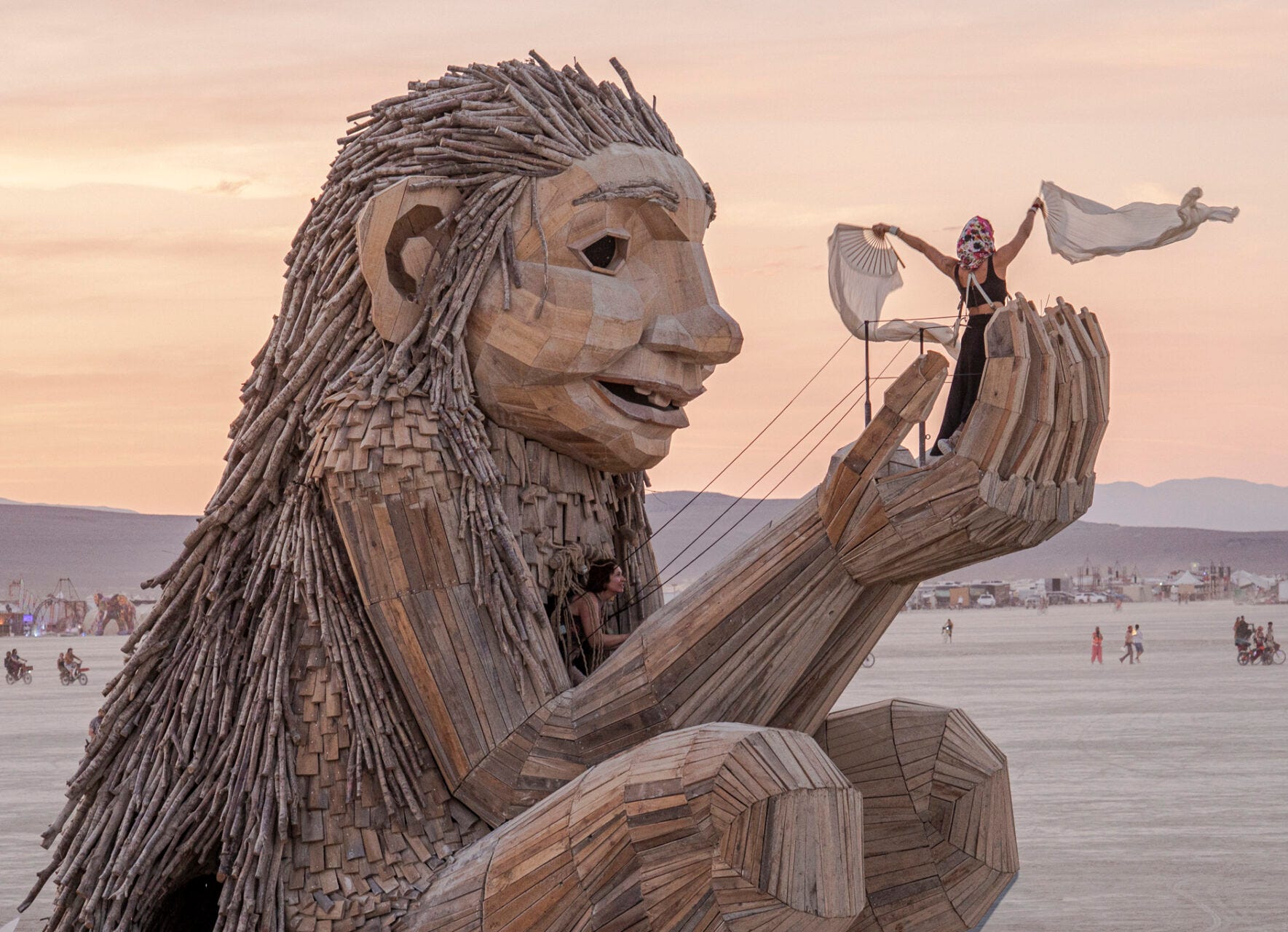
Another way to say this is that without a Burning Man, you might end up setting courthouses and police precincts on fire. That ritual conflagration of a titanic wooden effigy in the Black Rock desert which marks the climax of a techno music festival each year, is a symbolic reenactment of what happens when people have no creative release valve — they sacrifice each other.
The first Burning Man was set aflame by Cacophonists during a Stalker-themed event known as Zone Trip No. 4. Decades later, as both Sam Kriss’ and Chuck Palahniuk’s articles attest, the Happening has been co-opted by a cadre of ultra-wealthy, Bay Area transhumanist freaks worshipping a god of their own creation: Artificial Intelligence.
This is not medieval carnival, this is the Catholic Church on angel dust. Kriss’ article in particular reveals the extent to which Burning Man has become an elitist, navel-gazing, Silicon Valley circle-jerk.
But once, it was all fun and games.
Supplemental Texts (food for thought):
Eddington (2025), “a film about a data center.” Dir. Ari Aster.
“The Radicalization of Ziz LaSota: How an AI Doomer Became an Accused Cult Leader,” Rolling Stone. Dec. 2, 2025.
Empire of AI: Dreams and Nightmares in Sam Altman’s OpenAI (2025), Karen Hao.
Chapter 10, “Gods and Demons.” Scene from a Yosemite corporate retreat:
Sutskever [the head of OpenAI’s Safety Team] emerged. In the pit, he had placed a wooden effigy that he’d commissioned from a local artist, and began a dramatic performance. This effigy, he said, represented a good, aligned AGI that OpenAI had built, only to discover it was actually lying and deceitful. OpenAI’s duty, he said, was to destroy it. Only a few yards away, several redwoods stood like ancient witnesses in the darkness. Sutskever doused the effigy in lighter fluid and lit it on fire.
Merry Christmas.