Something Sacred
Through The Doors to the garden.

Legs McNeil wrote the seminal oral history of punk rock, Please Kill Me (1996).
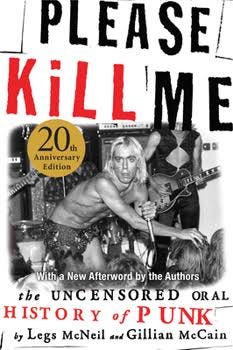
“Oral history” basically means interviewing key figures on the scene, and recording their thoughts in print—Boom. Book.
Lizzy Goodman emulated McNeil’s approach, in Meet Me in the Bathroom: Rebirth and Rock and Roll in New York City: 2001-2011, to great success. (I quoted one of Goodman’s interviewees, titling an article: “‘What do you think about Osama Bin Laden? What do you think about The Strokes’: How 9/11 created an international hipster stereotype.”)
Turns out, Legs McNeil, legendary among music freaks, is on Substack. His latest post is called: “Toilet Hugging Drunk With Jim Morrison.”
But it’s not by Legs McNeil. It’s by Tom Baker.
You (some of you) know him best as this guy, played by Michael Madsen (“Mr. Blonde,” from Reservoir Dogs), in Oliver Stone’s 1991 film, The Doors.
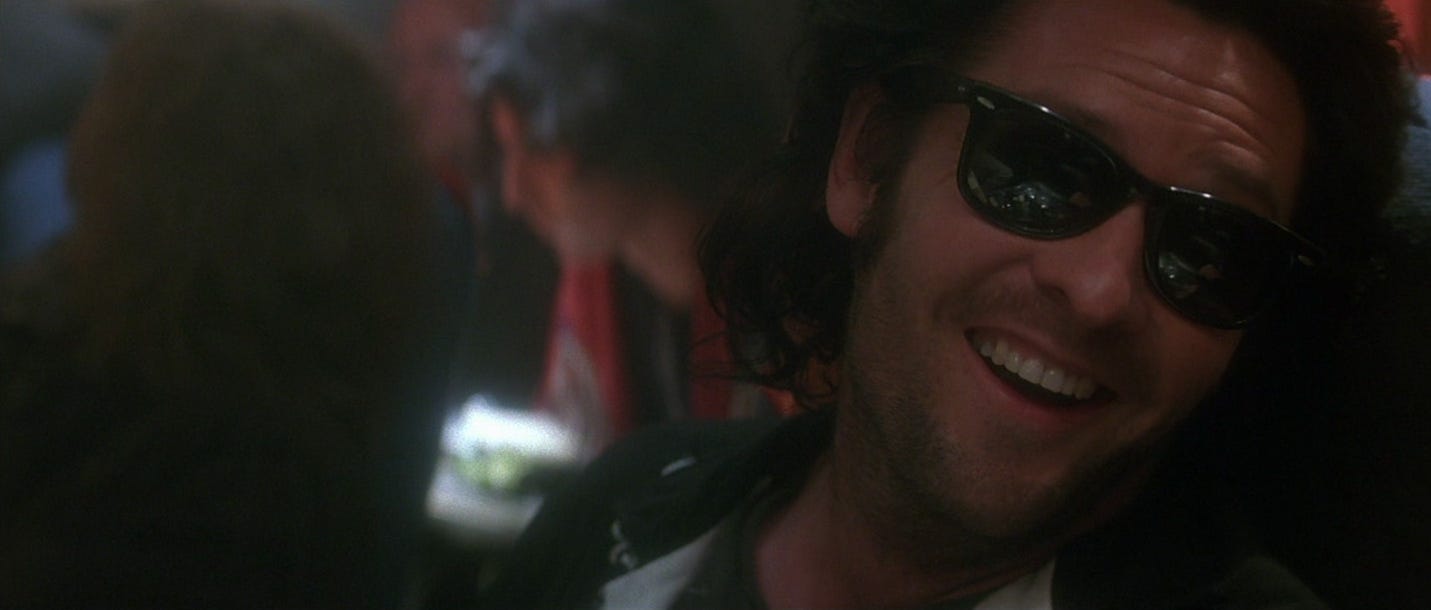
Tom Baker was a close friend, and drinking buddy, of Jim Morrison. He was also a close friend of Legs McNeil, who happens to be the literary executor of Tom Baker’s estate.
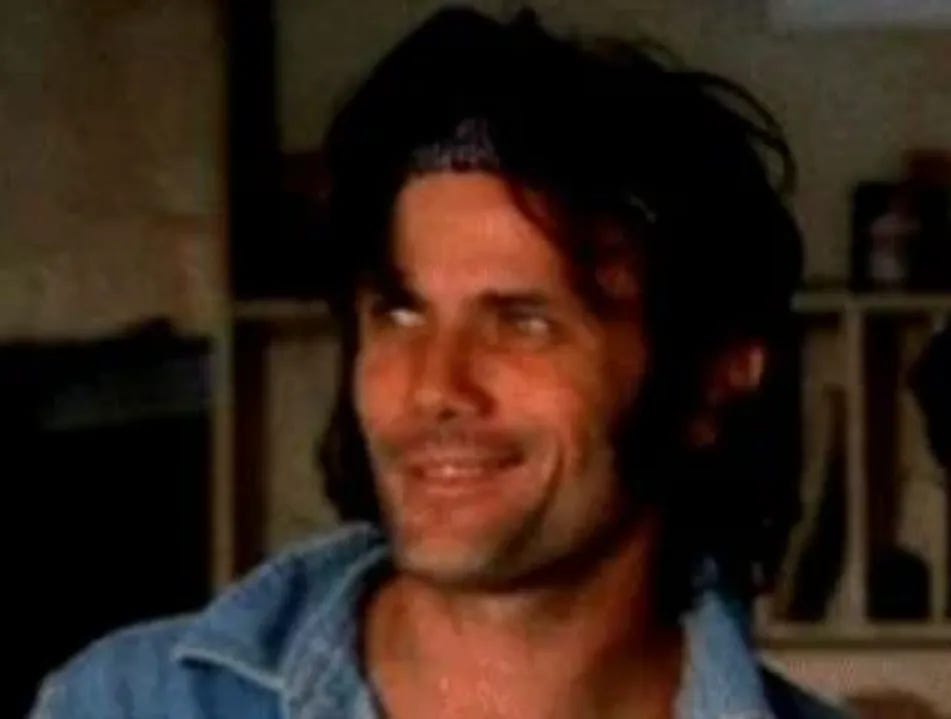
Morrison may have been a drunken buffoon. But as Camille Paglia told Willamette Weekly in 2005:
I take him seriously as a poet because he had vision and instinct, and I like his sense of myth. He had a great sense of archetype.
Elsewhere Paglia, who is very selective about literary genius, said Morrison had “real intellectual and poetic depth,” returned poetry to “oral performance,” tapped into “primitive energies,” and was a “shamanistic performer,” a priest in the tradition of Dionysus, as opposed to Apollo, in Nietzschean terms.
I won’t lie. Despite my reservations, and all the detractors—I agree with Camille Paglia.
If you’re a shameless Doors fan, or even a cautious one, you’ll want to read what McNeil has to offer from Tom Baker. I’ve seen every Doors documentary and biopic, heard every sound and lyric, read every interview I could get my hands on—and Tom Baker still has a few surprises. He’s a fine scribe to boot.
If you’re interested, click on the Legs McNeil link above. (I have five free gift subscriptions from McNeil—send me your email addresses.)
I bring this up because: a.) It’s a big deal Legs McNeil is on Substack and b.) I learned something from Baker’s article.
There’s a famous (to me) scene in Oliver Stone’s The Doors, where Tom Baker and Jim Morrison are on an airplane. In Oliver Stone’s telling, they’re on their way to a concert in Miami which, in Stone’s telling, will be the last Doors performance ever. In Stone’s portrayal, Tom Baker is an adult film star.
None of this is accurate. Baker was a serious, if struggling, actor and filmmaker. He and Morrison were actually en route to Phoenix, to see the Rolling Stones, and to hand out free tickets to anyone they happened to meet outside the arena, “From your old pal, Jim Morrison.” But the two were arrested for disorderly conduct on the flight, tried, and fined in Phoenix, with two female flight attendants testifying against them. They never saw the Rolling Stones.
But they did have drinks with the captain, and slept with the stewardesses who testified against them, hours after the verdict. You’ll have to read Tom Baker (at Legs McNeil) for the rest.
Oliver Stone incorporated this airline incident into a screenplay, and an influential film—changing many details along the way.
I read part of Oliver Stone’s screenplay, which is slightly different from the airline scene in The Doors, and wrote about it in the introduction to a book I never published. After reading Tom’s version of events, I revisited the introduction.
What follows—the unpublished intro to a book which never saw the light of day—encapsulates much of what The Third Ear is all about. In fact, it could have been my launch post.
Today, The Third Ear’s tagline is, “From the Icehouse to the Ivory Tower.” Three years ago, I described it as a “Church of Horticulture and the Humanities.” Either way, it’s reaching for the same thing.
Something sacred.
Something Sacred
Salvation hides in the damnedest places. Stowed-away aboard a jet airliner, or deadheading in a Steve Miller song. You know—“you got to go through hell before you, get to heaven”? That’s where we’re headed. I’ll give you a ride, but I can’t take you all the way.
Revelation hides in the damnedest places, too. Lurking in the laboratory, waiting between the lines of a song, words of a poète maudit, or in this case—buried in the dialogue of a Hollywood screenplay.
Rifling through Mary Shelley’s medicine cabinet, trying to locate the suture forceps, stitching needle, and most importantly, the thread—what holds this monster together (binds this book)—I discovered something more grotesque than Frankenstein or surgical instruments.
The brain of Jim Morrison, in Val Kilmer’s body.
The large mammal, a hybrid beast, spoke to me. In a throwaway line from Oliver Stone’s screenplay for The Doors, I found something sharp, if unsanitary, and something gripping, next to the galvanizing wire. And that damned thread, which I carefully stitched from the tissue of Stone’s script. I’d transcribed some of the dialogue a year ago, and left it to fester among a pile of rotting pages.
Let me bring it to life.
Jim Morrison, in the body of Val Kilmer, is sardonically addressing his sidekick. The sidekick is the man with “a great penis,” adult film star Tom Baker—Jim Morrison’s benign parasite, a Warhol Factory actor played by Michael Madsen.
The two are aboard a commercial flight from L.A. to Miami. Along with an entourage that includes producer Paul Rothschild, who’s already been cursed with the death of one brilliant singer, Janis Joplin.
The entourage, excluding Morrison’s three exasperated bandmates, are en route to the Doors’ final show, which will result in Morrison’s obscenity trial and ultimately, his public withdrawal to a Paris bathtub overdose—The End. The Doors, as a live band, will never recover from the aftermath of this flight.
In the meantime, while the keyboardist, guitarist, and drummer grow impatient awaiting Morrison’s arrival inside Miami’s Dinner Key Auditorium, Kilmer’s character, the delayed prima donna, is getting shitfaced on the way to the show, on the plane. A large biker named “Dog” squeezes from the lavatory and plops a bar of soap in Jim’s drink. Laughing at this prank through cigar smoke, loudly teasing a concerned Paul Rothschild, the Doors’ producer, to find him some heroin, Morrison turns his attention to Tom Baker. He’s about to tell his drinking buddy what we, the audience, are really after:
JIM:
Listen you two bit fuckin actor, you
underestimate the audience. You think
they all want a better job, a house,
two cars, money, that’s what you
think but you know what they really
want, Tom, in their lives, what they
really want —
TOM:
Tell me.
JIM:
(a whisper)
…something sacred, that’s what
they want, something sacred.
“Something sacred” is meaningless without something profane. Something Oliver Stone knows, and dramatizes next. The scene falls quickly, like a bad Doors concert, from pathos to bathos. From “something sacred” to profanity. The pornstar—“(the devil)”—Tom Baker, unmoved by the singer’s pretension, laughs up his drink:
Tom spews the contents of his mouth all over Jim in response. Jim throws his sandwich back at Tom… then another drink goes…
JIM:
Fuck you ignorant devil’s asshole
slave!
TOM:
No you. Something sacred. My cock
is sacred. Suck on that!
JIM:
I don’t eat shrimp.
The feast of friends devolves into a food fight, as a stewardess approaches with the captain. The captain promises to have them arrested when they land in Miami, if they don’t calm down.
In the film version (sans shrimp-dick joke), Morrison will have to wait until after the Doors’ final show—after receiving a sacrificial lamb from a vegetarian onstage, leading a snake dance through the audience, and (allegedly) exposing the sacred organ mentioned above—to be arrested, on obscenity charges in Miami-Dade County.
Kilmer-Morrison hits the mark. The hybrid beast is right.
We’re all looking for something sacred, beyond the profane world of shellfish, cocks, and devil’s assholes. While the film, like Jim Morrison’s stardom, grows exhausting after a while, Oliver Stone remains a master of pop symbolism. An interpretative mythographer, cultivator of screenplay archetypes and conspiracy theories (see: JFK, also 1991).
Years later, Stone reinserted the myths he created in The Doors (1991) into classical mythology and history. In Alexander (2004), Alexander the Great—inspiration for the real Jim Morrison’s image and persona as much as Dionysus, as dramatized in The Doors film montage where Val Kilmer-as-Jim Morrison appears alongside statues of both Greeks, Dionysus and Alexander the Great—in Alexander, the hero’s father, Philip II of Macedon, is played by Val Kilmer.
For American cinephiles, a dark-haired Val Kilmer is already synonymous with Stone’s version of Jim Morrison. When the Kilmer plays an alcoholic—when we see Alexander’s father cavorting drunk on his second-wedding night, there can be no mistaking the inspiration—it’s Morrison.
In a memorable scene Kilmer, as Philip II, tutors a young Alexander in Greek mythology, by pointing to paintings of figures like Prometheus in a torchlit cave. It’s impossible to overlook the ghost of an elder Morrison mentoring his own 2,300 year-old role model (Alexander the Great) as a young boy. Jim Morrison (Val Kilmer) fathering Alexander the Great, the mythical figure that fathered him (the biographical Jim Morrison, and his Alexander-Dionysus mythos). Val Kilmer as Philip II, with his palimpsest of Jim Morrison from The Doors, tells young Alexander that, "no man or woman can be too powerful or too beautiful without disaster befalling him."
Which is about is close as you can get to defining the archetype of the tragic rock star. “[R]itual figures of Dionysian excess,” as Camille Paglia characterized Morrison. The “romantic myth of the doomed poet.”
It’s as if Philip II is playing Oliver Stone’s Jim Morrison, and warning Alexander not to become him.
In another myth-laden scene, Alexander’s witchy mother (Angelina Jolie), a mystery-cult sorceress and snake charmer who goes by the name Olympias, explains to Alexander that he was actually fathered by Dionysus—not her ex-husband, Alexander’s biological father Philip II.
The doubling seems intentional, even tongue-in-cheek, to fans of The Doors. Alexander’s contested paternity is either Jim Morrison or Jim Morrison: Val Kilmer (synonymous with Jim Morrison because of The Doors) as Philip II, or the immortal Dionysus, now synonymous with the singer thanks to Doors mythology, and Stone’s film.
In a later scene, Olympias prophecies world conquest and future divinity for her son, now mature (Colin Farrell). The director zooms in: a pair of Olympias’ pet snakes intertwined, as if copulating—the sight that blinded the prophet Tiresias, gave him foresight, and temporarily turned him into a woman, according to Greek mythology. The symbolism is on the nose: Olympias is a true prophet, her vision of Alexander’s greatness will come true.
Ride the snake.
Throughout the film, Alexander is torn between the legacy of his one-eyed, boozy father and the designs of his snake-charming mother. Between Angelina Jolie, who always seems two seconds away from fucking Colin Farrell (her son Alexander), and Val Kilmer.
On Philip II’s second-wedding night, when Kilmer channels his Morrison persona from The Doors and makes a drunken mockery of Alexander and Olympias, the son vows to kill his father, newly remarried, and avenge his mother. An anonymous conspirator beats Alexander to the deed (someone else kills Philip of Macedon), but the Oedipal subtext is clear.
As The Doors expressed so eloquently one spooky night, as Paul Rothschild recorded them by candlelight—before his singer tried to set the studio on fire—in “The End”: “Father, I want to kill you. Mother, I want to… arrgghhh.”
A candlelit studio. A torchlit cave. Screenplay legends and pop idolatry. That’s what cultivating “the sacred” looks like in the twentieth century and beyond—signifying, tapping into something more: a shared ideal, a myth. These things connect us—to the past, to the ‘gods,’ to each other. It’s the divine glue of society.
It is all we have left.
As Christopher Hitchens put it, in his beautiful Foreword to Brave New World:
[W]hat would astonish laconic old Aldous would be the discovery that . . . Jim Morrison of The Doors had named his group after Huxley’s later and proto-psychedelic book The Doors of Perception. In America, as Joan Didion once wrote, people who say ‘No Man Is An Island’ think that they are quoting Earnest Hemingway: the fans who still make a shrine of Morrison’s grave in Paris probably don’t appreciate that Huxley himself was borrowing from William Blake. Nevertheless, literary immortality often depends on such vague but durable misunderstandings . . . virtual hieroglyphics which almost automatically summon a universe of images and associations.
Oliver Stone, for better or worse, is a master cultivator of vague but durable misunderstandings, images and associations.
The things we consider sacred are damn near profane. This is clearest in that system where symbols so often betray us, language.
I’m speaking of profanity, or cussing—sacred/profane words—our curses and oaths. What’s sacred is protected by taboos, the things we can’t say—which we confusingly label “profanity.”
Profanity reveals what we consider sacred at any historical moment—the names of the gods, by which we took our oaths, to use an example from the past. The Lord’s name in vain. Misuse is blasphemy, profanation, uttering holy words in the wrong context.
Think of the most offensive words you can possibly imagine, what you wouldn’t dare utter, today. Find the taboo words, find what can’t or shouldn’t be said, and there you will find the sacred, what’s most important to society at any given time. What are our taboo words? (I’ll give you a hint: most of them have to do with race, or sexualized body parts, especially feminized ones.)
That’s part of what I’m looking for: the sacred. The thread. The tie that binds. Communion. The magic circle. Something to put a halo around.
And all that profanity on the perimeter.
Whether or not anyone, let alone a dying rockstar, can give it to us, people want to connect with something beyond their mundane lives. To anoint something set apart (as the etymology suggests) from lay existence: to weave a circle ‘round it thrice, and sacralize it. The idol or medium is irrelevant, so long as it stands for something else, something more, and promises to communicate that.
Without the promise of communion and communication, we distract ourselves. Wallow in materialism, or fetishize the profane—“a house, two cars, money,” as Oliver Stone’s Jim Morrison tells Tom Baker. Sex, fame, a new identity, a new body, politics, activism, a therapeutic cause, feeling, substance, or drugs.
Otherwise we get religion. Or yoga or astrology, which is the same thing.
We’re all willing to accept someone, anyone, who’ll try to give us something more. An actor out on loan. A carpenter with new ideas. A teacher. A guru. A reality TV host, evangelist, or President.
We look for the sacred in the damnedest places.
Especially those of us who don’t consider ourselves religious. A reverence for Enlightenment and so-called Reason has finally blinded us to the fact that religious mannerisms creep in everywhere they’re least expected, when we don’t know what we’re about. What looks like hopeless superstition or savagery today was once perfectly reasonable; it still is, if we choose to understand the framework. What passes for secular enlightenment today may look like craven idolatry and ritualism tomorrow. But it will still be comprehensible, if we look at it right.
Mircea Eliade (1907-1986), a Romanian historian writing on the nature of religion, perceived in 1957 what has recently become a popular truism: “The ‘irreligious’ still behave religiously, even though they are not aware of the fact.” It’s become commonplace to claim that this-or-that is the “new religion”—political ideology, race, gender, conspiracy theories, the news.
Whether we like it or not, our modern secular philosophy was a swerve from religious superstition, and derives from it. The Enlightenment tried to empty Western philosophy of all superstition, rather successfully, by proposing we adopt a scientific outlook opposed to prior superstitious behavior. But, “that behavior is still emotionally present” to us, “in one form or another, waiting to be reactualized in our deepest being,” according to Eliade.
Aristotle claimed man is a political animal; Eliade claims he’s a religious one. They’re both right. When nothing is sacred, we will put a halo around something profane, and make it so. Even politics.
What is this religious behavior?
In Eliade’s words, a religious person “wants to be other than he finds himself on the ‘natural’ level and undertakes to make himself in accordance with the ideal image revealed to him by myths.”
I admit it. There was a time, called adolescence, when I undertook to ‘make myself in accordance with the ideal image revealed to me by myths’—the myth of Jim Morrison. As my mother once chided me in desperation, after she caught me drinking and smoking grass: Who do you think you are, Jim Morrison?!
Yes, I did. And I’m not the only one.
Religious behavior wants what Oliver Stone’s dying rock star wants for his audience: something sacred. Religious behavior is a longing for transformation, for becoming or connecting with an idealized image, something “other,” or outside ourselves, something apart. A number of objects, images, or techniques—potentially, anything—may be utilized to approach that ideal other, whatever it may be, according to whatever myths we inherit or choose.
Cicero derived the word religion from relegere, “to go through again.” The etymology seems appropriate, if not prophetic, considering Eliade’s idea that people, religious and irreligious alike, keep going through the motions of religion long after the old gods are dead. Relegere also points, I say, to the compulsive repetition inherent in all ritual, acts we “go through again,” and again.
As Paglia said of certain lyrical styles, including Morrison’s, “Repetition . . . creates a hypnotic effect,” chant-like, ritualistic.
An alternative pop etymology for religion, derived by later ancients including St. Augustine, argued that the root word for “religion” was another Latin verb, religare. “To bind fast,” as in the “bond between humans and gods.” This etymology is also appropriate to Eliade’s idea of the sacred: what binds us to the other—another time, another space, another persona, another way of being—an ideal.
Agnostics sometimes consider how to respond to an increasingly-rare (some say rude) form of modern inquisition: someone asking your religion. Most people of my disposition simply respond with “atheist,” “I don’t know,” or “nothing.”
“I’m not religious, but I’m very spiritual,” is a wearisome cliché. Right. “I’m not honest, but you’re very interesting,” a comedian once replied.
These answers are unsatisfactory, for the reason that, “‘irreligious’ people still behave religiously,” as Eliade said, and must account for some form of ritual practice connecting them with their ideals. “You gotta serve somebody,” or something, a recently-converted Bob Dylan once sang. You gotta pour those religious proclivities and sacred energies, consciously, into something.
Or else.
For me, I’m often tempted to claim that “gardening” is my religion: growing and tending plants and seeds. “Nature” is a tangential theology, shared by many a disaffected urbanite, for the same reason.
But religion (like art) is actually a means of escaping nature, explaining and describing, if not controlling, the terror of things as they are. Wilderness retreats are an effective ritual for reconnecting with mother nature, but designating such rituals sacred is an act of culture, over and against nature. It wouldn’t be necessary to reconnect with nature if we hadn’t already distanced ourselves from it, in some sense, through culture and abstraction.
Only through culture—civilization—has nature become other, sacred or desirable. Nature may be the wellspring of the gods, but anyone dwelling in a pure state of nature quickly develops some form of sacred armor to protect against it. Inventing gods was a reaction to nature; divinities may embody it, represent it, but without them the nature we worship is chaos, and we quickly want out of that.
Agriculture, in my case gardening, marks the threshold between culture and nature. The perimeter, a fence or furrow between the sacred and profane. The horti-cultural-ist straddles both. Gardening is cultivation, an art. Whether it contains an arrangement of plants, water, or rocks, a garden is a work of culture in the medium of nature. “Garden” means enclosure, like the name of the royal game park and orchard described in ancient Persia—paradise: walled against nature, yet containing it. A magic circle, filled with edible plants and animals.
An Eden.
To put it another way, “garden” and “paradise” are perfect examples of humans imitating nature, and whenever we hold a candle to that behavior, mimesis, we discern the watermark of magic and religion.
Growing seeded plants and herbs, gardening vegetables, taps into a cyclical order outside of horizontal time and history, beyond life and death. To control something that grows and dies to be reborn, consuming it along the way, is classic ritual.
Fertility culture is the vegetable inspiration behind resurrection cults from Bacchus-Dionysus and Christ to Elvis, who as people once said, “isn’t dead” but “lives”—in the minds of a million hopeful fanatics and faithful impersonators who claimed to witness the King alive years after his death. A similar myth dogged the death of Jim Morrison, who died six years before Elvis, in similar bathroom fashion, and was also spotted about town in his shroud.
The urban legends are modern reboots of the resurrection myth—fertility worship, by people fascinated with rebirth—the story of imitating vegetables. But I’ve yet to write the comparative religion of gardening, and that is not what the stories and essays in this collection [now, The Third Ear] are about. (Though as you can see, some of them come close).
I consider the humanities my religion. My religion is the study of all religions; all symbolic patterns of thought and creativity, and what they tell us about ourselves—what it means to be human. Literature, art, and history—anything that connects us to the family of man, our origins, our psychology, and what makes us tick. Pop culture, music, and film. Travel narratives. Fashion. Philosophy, politics, pornography. Body modification. You name it. To crib from Terence and Tennessee Williams: nothing human is alien or disinteresting to me (though some of it may be disgusting, especially when it’s unkind).
Taken literally, Cicero’s word for religion means “to reread.” Re-legere, to return to something religiously is a habit of reading and thinking. To reread, rethink, and revisit, my incurable vice.
A sacred one, which I invite you to sample along the way.