

Smoke Signals
Content and Discontent in "Amusing Ourselves to Death"


Amusing Ourselves to Death
Neil Postman, a media theorist influenced by Marshall McLuhan, published a critique of America’s love affair with television, Amusing Ourselves to Death, in 1985.

“All I can say about Neil Postman’s brilliant Amusing Ourselves to Death,” Matt Groening, the creator of the longest-running show on television, The Simpsons, said, “is: Guilty as charged.”
“As a fervent evangelist of the age of Hollywood,” critic Camille Paglia admitted, “I publicly opposed Postman’s dark picture of our media-saturated future. But time has proven Postman right.”
In 1985 (as Neil’s son Andrew introduces the 2006 edition, returning readers to the world in which Amusing Ourselves was penned): “The Mac computer [wa]s one year old.”
Yet the messages Postman delivers from 1985, about television, apply to screens today.
As one of Postman’s students said: “It’s a twenty-first century book published in the twentieth century.”
Critics said the same about Marshall McLuhan’s Understanding Media (1964) and The Gutenberg Galaxy (1962), where he coined the aphorism “the medium is the message,” and the concept of “the global village” (aka: the World Wide Web).
An intellectual celebrity in the 1960s, McLuhan was dismissed, by some, as an obscurantist kook in the 1970s-1980s. (He even parodied himself in Woody Allen’s Annie Hall (1977)). Once the internet came online, however, postmortem, McLuhan’s reputation revived. Now he’s considered a prophet of the digital age.

Postman met McLuhan thirty years before he wrote Amusing Ourselves to Death, as a grad student. He “believed then, as I believe now, that [McLuhan] spoke in the tradition of Orwell and Huxley—that is, as a prophesier.”
I believe, along with Groening and Paglia, that Postman, while not foreseeing everything correctly in Amusing Ourselves to Death—just as Postman posits a few errors on McLuhan’s part—works in the same tradition: prophecy.
Postman argues that as far as America is concerned, Aldous Huxley’s Brave New World, published in 1932 and set around 2540, was a more accurate prediction of Western culture than George Orwell’s 1984, published in 1949.
As Postman explains in the foreword, while writing Amusing Ourselves to Death: “We were all keeping our eye on 1984. When the year came and the prophecy didn’t, thoughtful Americans sang softly in praise of themselves. The roots of liberal democracy had held.”
But…
What Orwell feared were those who would ban books. What Huxley feared was that there would be no reason to ban a book, for there would be no one who wanted to read one. Orwell feared those who would deprive us of information. Huxley feared those who would give us so much that we would be reduced to passivity and egoism. Orwell feared the truth would be concealed from us. Huxley feared the truth would be drowned in a sea of irrelevance. Orwell feared we would become a captive culture. Huxley feared we would become a trivial culture, preoccupied with some equivalent of the feelies, the orgy porgy, and the centrifugal bumblepuppy.
The last three pseudo-words are the names of diversions in Brave New World that closely resemble: virtual reality, polyamorous sex, and a government-mandated game used to socially condition children, called Bumble-puppy.
As Matt Taibbi told Walter Kirn last month on America This Week (a political podcast that ends with an impromptu book club where the journalist and novelist discuss prophetic literature in the context of current news): “I remember reading [Brave New World] the first time and feeling like it was a pale imitation, or not an imitation, like a pale prelude to 1984. But actually, there are lots of aspects of this book that get the present more right than 1984 does.”
Postman would agree. Amusing Ourselves to Death, he said, “is about the possibility that Huxley, not Orwell, was right.”
This article is about the possibility that Huxley, and Orwell, were right.
Along with another novelist, who wouldn’t publish his own prophecy until eleven years after Amusing Ourselves to Death: David Foster Wallace, in Infinite Jest (1996).
Content and Discontent
Postman, “remained steadfast to [McLuhan’s] teaching that the clearest way to see through a culture is to attend to its tools for conversation.”
By conversation, he refers metaphorically not just to speech, but to “all techniques and technologies that permit people of a particular culture to exchange messages.”
For Postman, “all culture is conversation . . . conducted in a variety of symbolic modes.” Cave paintings. Songs. Hieroglyphics. The alphabet. Radio. TV. YouTube. Twitter (X). These forms of “conversation,” “regulate and even dictate what kind of content can issue from such forms.”
I italicize content here, not only because it’s become an absurd Silicon-Valley euphemism for everything from art and philosophy to advertising and AI slop, but because content is hiding in another word that recurs in Postman’s book, and in twenty-first century handwringing about screen addiction, loneliness, and political chaos: discontent.
For all our attention to so-called content, our screens permit very little of it to be transmitted meaningfully. As a social-media culture, we are not happy. Our lives are, and are not, content.
A more humane technology for social discourse, one that Postman is quite keen on, is the written word.
As Susan Sontag remarked in “One culture and the new sensibility”(1965): “What gives literature its preeminence is its heavy burden of ‘content,’ both reportage and moral judgement.”
In 1965, Sontag foresaw that the “arts of our time are actually those with much less content.” “[T]hese arts,” she said, “which draw profusely, naturally, and without embarrassment, upon science and technology—are the locus of the new sensibility.”
Sontag was talking about avant-garde music, new-wave cinema, and performance art, but she was correct about us veering towards “One culture,” sharing a “new sensibility” in which art is subsumed by technology. She was also right about Happenings, a form of performance art I compared (here and here) to modern street protests, when she said that in Happenings, the “scapegoat is the audience.”
Another way of saying “the scapegoat is the audience” is that when something bad happens (violence, exploitation), societies often blame consumers of content, not the creators. And when it comes to street protests, people on all sides—left, right, law enforcement—get blamed, and sometimes sacrificed.
Postman was not a luddite. He appreciates television as a form of entertainment. Or, to use a word synonymous with addictive food and opiates, junk: “The best things on television are junk.”
His gripe is that we shouldn’t measure a culture by its junk entertainment—by its infinite cat videos, say—but by what it presents to the world and posterity as significant. And our current medium, the screen (then and now), “presents itself as a carrier of important cultural conversations.” Important conversations that can’t be had in a 24-hour news cycle, or 280-character tweet.
The Philosophy of the TV Commercial
By 1985, Americans had accommodated themselves, “to the philosophy of the television commercial.”
For television commercial, we might easily substitute “social media feed.” The TV commercial, like the Instagram feed, “insists on an unprecedented brevity of expression. One might even say, instancy.”
It “addresses itself to the psychological needs of the viewer. Thus it is not merely therapy. It is instant therapy . . . [it] asks us to believe that all problems are solvable, that they are solvable fast, and that they are solvable fast through the interventions of technology, techniques and chemistry. This is, of course, a preposterous theory about the roots of discontent.”
The absurd concept of the chatbot therapist (which, as Nabokov would remind us, contains the words the rapist), comes to mind. Or the mindfulness techniques and herbal supplements hawked by guru influencers. The constant stream of Hims, Hers, ketamine therapy, and ADHD medication ads fed to the average Instagram viewer. This is not content. This is dis-content. Dis-information.
This, we should “diss.”

As Postman contended, “the television commercial has mounted the most serious assault on capitalist ideology since Das Kapital.”
Despite capitalism’s suss reputation, and the haute-ness of Mamdani socialism among Gen-Z, “capitalism, like science and liberal democracy, was an outgrowth of the Enlightenment.”
If greed was taken to be the fuel of the capitalist engine, then surely rationality was the driver. The theory states, in part, that the buyer not only knows what is good for him but also what is good . . . In America, there even exists in law a requirement that sellers must tell the truth about their products, for if the buyer has no protection from false claims, rational decision-making is seriously impaired.
If 2020s Super Bowl ads are any indication, Americans don’t even know what half the products are, let alone what is “good” for them. Most are for nebulous AI products. In 2026, the Super Bowl’s largest ad buy was for Novo Nordisk’s weight-loss drug, Wegovy.
The pharmaceutical ad warning whispered at 5x-speed during the last three seconds of a drug commercial is the greatest silver-tongued parody of the “requirement that sellers must tell the truth about their products” ever produced.
These same products are among the principal sponsors of televised news. Pfizer led Big Pharma advertising during coverage of the 2020 Republican and Democratic conventions on MSNBC. “Drug ads,” as CNNBusiness reminded readers 2025, “which are illegal in most countries, have been a hallmark of US television since the 1980s.”
Last time I checked, even the burlesque of disclaimers warning consumers about the side-effects and drug-interactions of FDA-approved products is absent on social media ads pushing controlled substances that aren’t even legal in most states.

In 2023, while another Novo Nordisk product (Ozempic) was the talk of tinseltown, the biggest advertiser during Oscars coverage was Pfizer.
Beginning in 2029, Conan O’Brien announced at the 2026 Academy Awards, the Oscars will be broadcast only on YouTube.
The host and Jane Lynch performed an amusing satire about this announcement. But Conan wasn’t joking. In 2029, the Oscars are moving from ABC to Alphabet.
Smoke Signals
Postman’s main contention is that the technologies that permit us to exchange messages and information—all conversation, which is culture—determine the content of that culture, what can be said and understood. This is what McLuhan meant by “the medium is the message.”
Take for example, one form of communication: my titular “Smoke Signals.”
Smoke signals are an amazing technology for transmitting particular sorts of information over great distances quickly, especially for such a primitive form of communication: Dinner is ready. The Cavalry is coming. Help! Alternatively, Run!
But, as Postman notes, “Puffs of smoke are insufficiently complex to express ideas on the nature of existence […] You cannot use smoke to do philosophy. Its form excludes the content.” In the same way, you cannot engage in a complex conversation—a complex culture—through the medium of smoke screens, “a conversation in images.”
I’m reminded of another form of Smoke Signal…

Observing minuscule protests developing outside of Portland’s Immigration and Customs Enforcement facility last October, where people in various costumes—frog suits, “We Are Charlie Kirk” T-shirts—were signaling to, and live-streaming, one another.

As I remarked to reporter Nancy Rommelmann at the time: “It’s like the internet come to life.” Aside from the actual smoke signals—tear gas and pepper balls—issuing from ICE agents at random (signaling: Get back!), there was a small contingent (maybe twenty people)—every “citizen journalist,” activist, or influencer—pointing cameraphones and selfie-sticks at each other: a “conversation in images,” as Postman says.
Pro-ICE and Anti-ICE actors, all filming their own personal TV commercial on their own personal TV station—YouTube. For anyone who wasn’t there, and even for those of us who were, the meaning of these fragmented smoke signals—the content—was up for grabs.
This one (by an actual reporter, not for YouTube) comes closest to capturing the vibe that night: a tepid standoff.

The following night, a MAGA influencer named Nick Sortor was arrested by Portland police for disorderly conduct, after “rescuing” (stealing) a burning American flag from a protestor. This minute interaction with a handful of kooks was broadcast on Sortor’s YouTube channel.
Six days later, Sortor was invited to D.C. for what the president deemed a “White House roundtable.” What political historian Daniel J. Boorstin would have called a pseudo-event. In Postman’s paraphrasing: “an event specifically staged to be reported—like the press conference.”
A more significant legacy of electronic media, Postman, riffing on Boorstin, dubs the pseudo-context:
A pseudo-context is a structure invented to give fragmented and irrelevant information a seeming use. But the use the pseudo-context provides is not action, or problem solving, or change. It is the only use for information with no genuine connection to our lives. And that, of course, is to amuse. The pseudo-context is the last refuge, so to say, of a culture overwhelmed by irrelevance, incoherence, and impotence.”
Nancy has written brilliantly about the pseudo-context of this pseudo-event—the flag-burning “rescue” and the White House roundtable afterwards (and quotes me), here. She describes Sortor presenting the singed flag to the president, who responded, “At least that horrible night”—when an influencer grabbed a flaming flag and stomped on it in about fifteen seconds—“made you famous.”

The day before Sortor attended the White House roundtable, former U.S. Homeland Security Secretary Kristi Noem, affectionately known as the “ICE Barbie” for her many costumes—variously cosplaying as Rambo, a nurse, firefighter, dentist, pilot, Marine, prison warden, Coast Guard, and other personalities in her public appearances and ad campaigns (the last of which allegedly funneled $220 million of DHS taxpayer money to film a commercial of Noem in front of Mt. Rushmore on horseback, dressed as a cowgirl, warning illegal immigrants, “Break our laws, we’ll punish you”)—made another appearance, on the roof of the Portland ICE facility. This time, dressed in understated tactical black and sunglasses.

She was there to make another sort of TV commercial. To send the message that (as she remarked the following day at the White House roundtable), Antifa—who in her mind was synonymous with the handful of protestors bellow, including a guy in a chicken costume—were as “sophisticated” and “dangerous” as “ISIS,” “Hezbollah,” and “Hamas.”
Portlanders mocked Noem’s rooftop performance by blasting Benny Hill’s “Yakety Sax” from loudspeakers below—the theme song from the British vaudeville TV series. The playlist was perfect.
As Postman says, “In presenting news to us packaged as vaudeville, television induces other media to do the same, so that the total information environment begins to mirror television.”
[It] is a theory of anticommunication, featuring a type of discourse that abandons logic, reason, sequence and rules of contradiction. In aesthetics, I believe the name given to this theory is Dadaism; in philosophy, nihilism; in psychiatry, schizophrenia. In the parlance of the theater, it is known as vaudeville.
Katherine Dee, a self-described “internet anthropologist” with whom I often disagree but who has nonetheless done some astute research about life online, has described “internet personalities as continuous works of art, TikTok as digital vaudeville.”
As far as Noem is concerned, Postman also said, defending his thesis that Huxley was more accurate than Orwell:
Orwell thought of Newspeak as originating, in part, from “the verbiage of commercial advertising.” But when Orwell wrote in his famous essay [“Politics and the English Language”] that politics has become a matter of “defending the indefensible,” he was assuming that politics would remain a distinct, though corrupted, mode of discourse. […] That the defense of the indefensible would be conducted as a form of amusement did not occur to him. He feared the politician as deceiver, not as entertainer.
As it turns out, the politician is both deceiver and entertainer—a schizophrenic, vaudevillian one at that. Between Noem’s various costume changes and multiple personalities, she labeled Minneapolis protestors Renee Good and Alex Pretti, slain by ICE agents, as “domestic terrorists,” claimed Good was “stalking and impeding” ICE throughout the day, and had “weaponized her vehicle” against the ICE agent—who switched his firearm from one hand to other, the better to film the incident with his smartphone—who shot her as she drove away. Only one of these claims—that Good had “weaponized her vehicle”—is even remotely defensible, to some observers.
As Kat Rosenfield has argued, Minneapolis Isn’t a Movie. Many protestors may be under the dangerous illusion that their role in the #Resistance isn’t closer to actor than activist.
But in the course of this tragic farce, Noem and her agents still deceived, and amused us, to death.
Electric Politics
There’s a legitimately amusing scene, in the 1985 Robert Zemeckis film Back to the Future—released the same year as Amusing Ourselves to Death—where Marty McFly, a time-traveling teen from 1985, tries to convince his mentor Emmett “Doc” Watson, the inventor of the time machine, that he’s used Doc’s souped-up DeLorean to travel back to 1955.
Naturally, in 1955, Doc is skeptical: “[T]ell me, Future Boy, who’s President of the United States in 1985?”
McFly tells him. The president is a former two-bit thespian.
“Ronald Reagan, the actor? Hah!”
A few minutes later, when McFly shows Doc an image of himself as an old man on a camcorder, he gets it. “This is truly amazing,” Doc marvels, “a portable television studio. No wonder your president has to be an actor, he’s gotta look good on television!”
“As I write,” Postman scribbled, the same year audiences were introduced to Back to the Future, to illustrate the same point, “the President of the United States is a former Hollywood actor.”
As I write, the President of the United States is a former reality TV star. Also, a former WWE wrestling jock and beauty pageant host.
Cosmetics
If, as Toni Morrison wrote (tongue-in-cheek), Bill Clinton was our first “black president,” then Trump, as others have joked, may be our first “gay president.”
Meaning that, although he may technically be fat and bald, like a drag queen, he’s an expert in the use of cosmetics to disguise his gaps and bulges onscreen.
Postman:
Although the Constitution makes no mention of it, it would appear that fat people are now effectively excluded from running for high political office. Probably bald people as well. Almost certainly those whose looks are not significantly enhanced by the cosmetician’s art. Indeed, we may have reached the point where cosmetics has replaced ideology as the field of expertise over which a politician must have competent control. [Emphasis mine.]
An under-appreciated film, a 2024 biopic called (like Trump’s former reality TV show) The Apprentice, not only offers a glimpse into the 1970s and 1980s world that informed the president’s conception of media and politics. The final scene suggests the future of “cosmetics replacing ideology”: the future leader of the free world, undergoing a grotesque sequence of liposuction and scalp reduction surgeries. (I could mention a few other types of cosmetic surgery that replaced, or became synonymous with, ideology in the 2020s, but that it is a subject for another post.)
Spectator Sport and Show Business
In The Last Hurrah, Edwin O’Connor’s 1956 novel about Boston politics, one bareknuckle politician declares that: “Politics is the greatest spectator sport in America.”
In 1966, while running for governor of California, Postman also notes, Reagan declared: “Politics is just like show business.”
Trump combines both, and mediates them on Twitter and (after he was banned) his own social media platform, Truth Social.
On June 14 (the president’s 80th birthday), less than a month before the United States’s semiquincentennial, Trump has announced, the Ultimate Fighting Championship (UFC) will spend $60 million sponsoring an MMA bout scheduled to take place on the White House South Lawn. (Trump’s Secretary of Education, Linda McMahon, is the estranged wife of Vince McMahon, best known for his roles as a movie producer and co-founder of World Wrestling Entertainment, where he once staged a “Battle of the Billionaires: Hair vs Hair” with Trump.) This is politics as spectator sport, and show business.
As an article from last week points out, “Sports were integral to the early success of television,” and wrestling and boxing—similar to the WWE and UFC—were two of its biggest draws. “Wrestling might or might not be a sport, but it was definitely entertainment,” Virginia Postrel writes. Spectator sports were, as the article’s title suggests, “How TV Learned to Sell Itself.”
Image and Reflection
On television, Postman wrote, “the politician does not so much offer the audience an image of himself, as offer himself as an image of the audience. And therein lies one of the most powerful influences of the television commercial on political discourse.”
This is Trump, Obama, and many others, in a nutshell. In the current president’s case: a symbol of the disenfranchised, the outsider, the deplorable. Who also happens to be a billionaire. It works both ways for him—the audience sees themself in him, and wants to be him. Mimetic Desire and self-recognition.
Celebrity
Postman offers an astounding list of politicians who appeared as celebrity guests on TV shows from the 1950s onward, most notably Gerald Ford and Henry Kissinger on Dynasty, Speaker of the House Tip O’Neill on Cheers, Nancy Reagan on Diff’rent Strokes, and Ralph Nader, Edward Koch, and George McGovern, all of whom, like Trump (twice), hosted SNL.
There are too many Trump celebrity cameos to mention without veering into encyclopedia, but some notable ones include the films Home Alone 2, The Little Rascals, 54 (about Studio 54), Zoolander, and Wall Street: Money Never Sleeps. He’s also appeared on The Fresh Prince of Bel-air, The Nanny, Spin City, and Sex in the City. In nearly every scene, he’s played himself. The Trump cameo that flitted across my screen most recently was from Woody Allen’s black-and-white meditation on the phenomenon itself, Celebrity (1998).
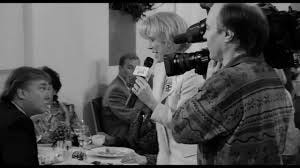
As Postman says, “Political figures may show up anywhere, at any time, doing anything, without being thought odd, presumptuous, or in any way out of place. Which is to say, they have become assimilated into the general television culture as celebrities.”
Is it any wonder that the reverse would happen: that the reality-TV culture of celebrity would become assimilated into politics? That our female cabinet members would start dressing like beauty pageant contestants? That the Director of the FBI would invite UFC fighters to train his agents? That half of Mar-a-Lago (including Kristi Noem) would become ideologues of “the cosmetician’s art,” plastic surgery?
Political Parties
“Although it may go too far to say that the politician-as-celebrity has, by itself, made political parties irrelevant,” Postman muses, “there is certainly a conspicuous correlation between the rise of the former and the fall of the latter.”
I would say it doesn’t go far enough.
There is no Republican party, just a single personality. And there is no coherent Democratic party either, really, just Barack, Michelle, and Netflix. The politico who finally convinced Democrats to jettison Joe Biden in favor of Kamala Harris in 2024? George Clooney. The famous director who used “Hollywood magic” to help Biden with his “communication struggles” during his glorious State of the Union and disastrous televised debate in 2024? Steven Spielberg.
(“Election”) Results
All of this had a deleterious effect on politics, Postman feared, and we’re not even in the age of social media yet. Already, in 1985, voters assumed:
[S]hort and simple messages are preferable to long and complex ones; that drama is to be preferred over exposition; that being sold solutions is better than being confronted with questions about problems. Such beliefs would naturally have implications for our orientation to political discourse; that is to say, we may begin to accept as normal certain assumptions about the political domain that either derive from or are amplified by the television commercial . . . that all political problems have fast solutions through simple measures . . . that complex language is not to be trusted, and that all problems lend themselves to theatrical expression. Or that argument [or debate] is in bad taste, and leads only to an intolerable uncertainty. Such a person may also come to believe that it is not necessary to draw any line between politics and other forms of social life.
Electric Church
Appropriately, Postman’s chapter about TV’s effect on politics is preceded by his chapter about TV’s effect on religion. Specifically—this is 1985—he writes about televangelism.
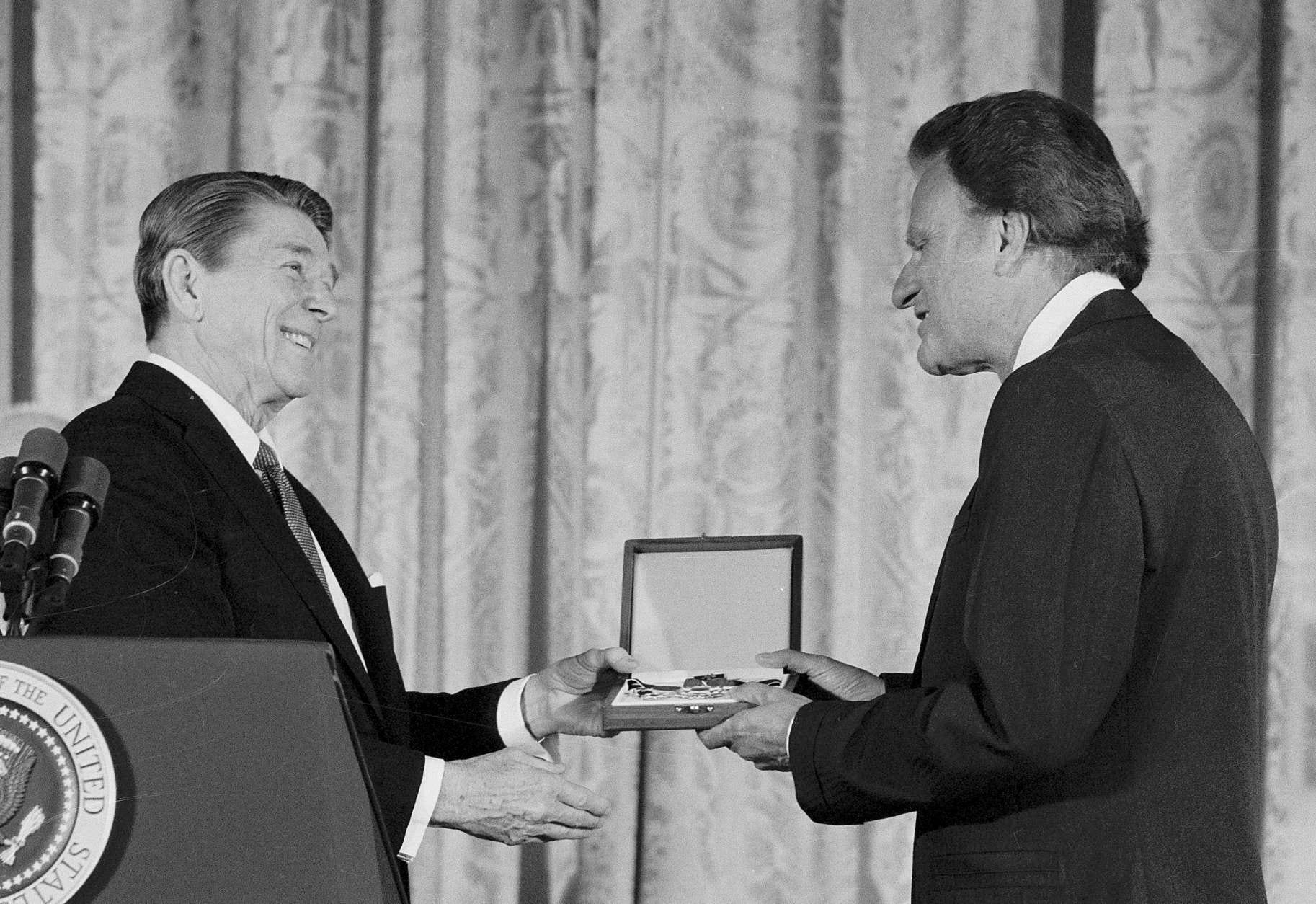
In an earlier chapter, in an anecdote about Billy Graham attending a tribute for comedian George Burns (where the preacher is surrounded by showbiz celebrities), Postman says, “Although the Bible makes no mention of it, the Reverend Graham assured the audience that God loves those who make people laugh. It was an honest mistake. He merely mistook NBC for God.”
News as Religion
Matt Taibbi wrote something similar in 2021, about mistaking NBC for God: “The News is America’s New Religion, and We’re in a Religious War.” An essay about political narratives—network news as entertainment—replacing faith.
Of course, as Taibbi knows, the 1976 film Network beat him to the punch by half a century.
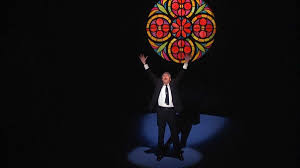
Postman makes a similar point:
Television’s strongest point is that it brings personalities into our hearts, not abstractions into our heads. That is why CBS’ programs about the universe were called Walter Cronkite’s Universe. One would think that the grandeur of the universe needs no assistance from Walter Cronkite. One would think wrong. CBS knows that Walter Cronkite plays better on television than the Milky Way. And Jimmy Swaggart plays better than God . . . If I am not mistaken, the word for this is blasphemy.
Celebrity as God
Today we might add Morgan Freeman’s Through the Worm Hole and The Story of God with Morgan Freeman, hosted by a lovable actor who has played the Almighty twice elsewhere, in Hollywood films.
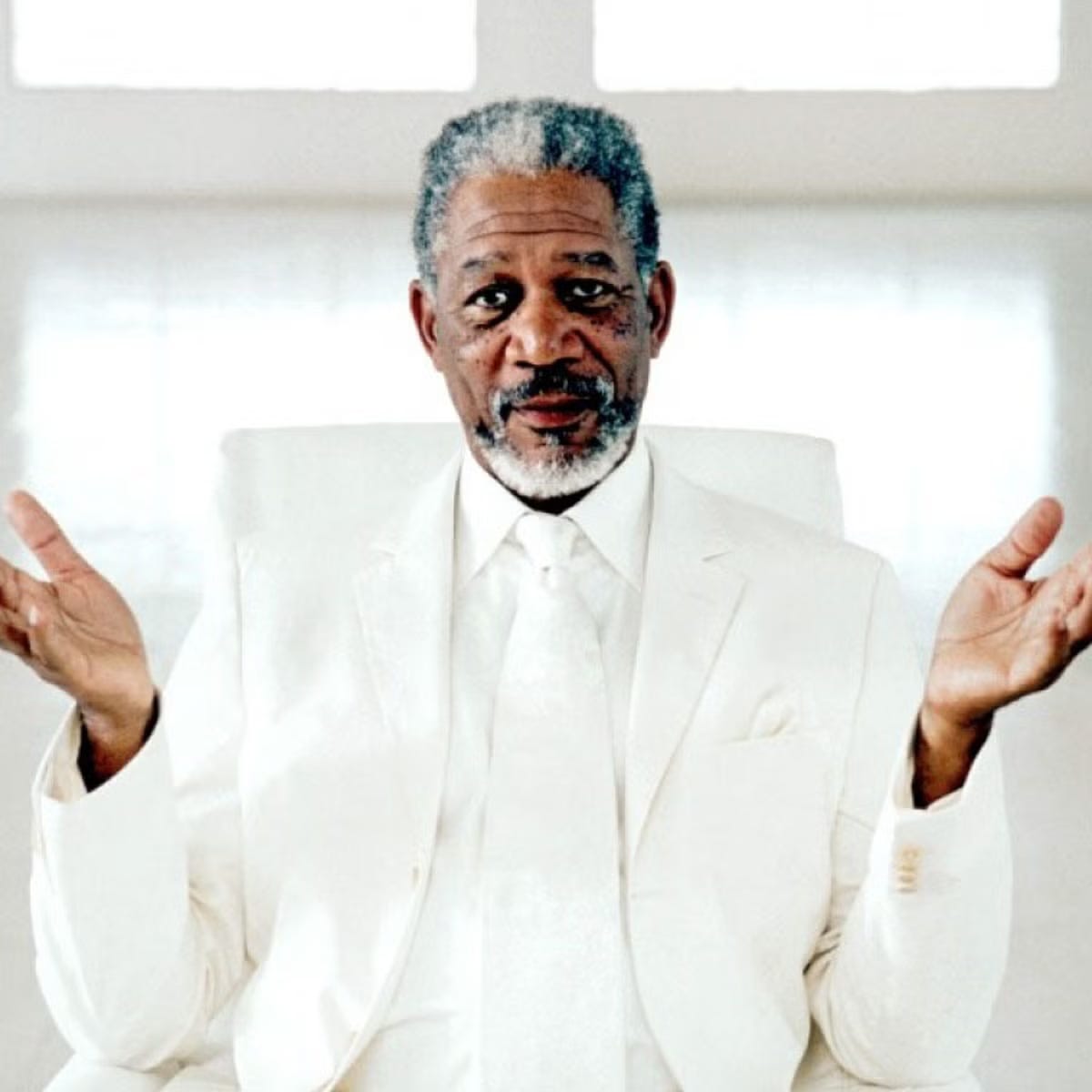
In the premier episode of The Story of God with Morgan Freeman, “Beyond Death,” transhumanist Martine Rothblatt and her wife Bina explain Martine’s desire to create an AI robot version of her wife, Bina48, which will grant her immortality. If I’m not mistaken, this is another form of blasphemy. (Morgan Freeman, whom I like, began his career on Sesame Street, a show for which, as we’ll see, Postman reserves special ire.)
Postman was a member of the Commission on Theology, Education and the Electronic Media of the National Council of the Churches of Christ. You might assume he was some sort of Christian. You would assume wrong. He was a mostly non-observant Jew, who was nonetheless concerned about how TV was warping authentic religious experience.
“It is well understood at the National Council,” he said, “that the danger is not that religion has become the content of television shows but that television shows may become the content of religion.”
He quotes George Gerbner, Dean of the Annenberg School of Communication: “Television is the new state religion run by a private Ministry of Culture (the three networks) offering a curriculum for all people, financed by a form of hidden taxation without representation.”
Today we could substitute the three biggest AI companies, and the digital gods they claim to be building, as the new state religion run by a private Ministry of Culture, financed by a hidden form of taxation without representation: data collection and defense contracts.
Postman returns to his Jeremiad against televangelism:
[O]n television, religion, like everything else, is presented, quite simply and without apology, as an entertainment. Everything that makes religion an historic, profound, sacred human activity is stripped away: there is no ritual, no dogma, no tradition, no theology, and above all, no sense of spiritual transcendence. On these shows, the preacher is tops. God comes out as second banana.
Politics as Religion
It is has often been remarked that there is a “cult” of Trump—in other words, to some, including many evangelicals, he’s a kind of religious figure. I would argue rather that at some point around 1985, religious figures and celebrities became conflated.
“Electronic preachers,” as they were called, televangelists in the 1980s, used celebrities to attract an audience, their main goal. On Pat Robertson’s 700 Club, for example, the chorus girls in Don Ho’s Hawaiian act, all born-again Christians, were part of the set.
“To achieve this goal” of attracting an audience, “the most modern methods of marketing and promotion are abundantly used, such as offering free pamphlets, Bibles and gifts, and, in Jerry Falwell’s case, two free ‘Jesus First’ pins. The preachers are forthright about how they control the content of preaching to maximize ratings.”
If that doesn’t sound vaguely reminiscent of the 47th president—televised gatherings, brandname Bibles, “Something First” pins, free and not-so-free swag, some of it featuring graven images of the head showman, concerned above all with ratings—maybe I’m preaching to the wrong choir.
This is not to argue Trump is some profound religious leader. “There is no great religious leader . . . who offered people what they want,” Postman said, “Only what they need. But television is not well suited to offering people what they need. It is”—in the parlance of Apple Computers and handheld devices—“user friendly.”
“Television,” as the Reverend Billy Graham wrote, “is the most powerful tool of communication ever devised by man . . . in a single telecast I preach to millions more than Christ did in his lifetime.”
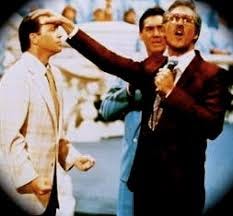
This sort of hubris, plus the campy aesthetics of televangelism (and the subsequent financial fraud and sex scandals of Jimmy Swaggart, Jim and Tammy Bakker, Jerry Falwell Jr., et al) made church TV ripe for parody. Americans, some of them, were not as spiritually credulous as Postman might make it sound in his accounts of televangelism. By 1989, Chevy Chase was poking fun at real-life TV evangelist Peter Popoff as “Jerry Lee Farnsworth” on Fletch Lives, exposing the preacher’s “healing touch” routine.
Attention Economy: Sports and Spirit
Nevertheless the Electric Church, as Postman calls it, was big business. There were thirty-five televisions shows owned and run by religious organizations circa 1985, and every major network featured religious programming of some sort. Donations to these shows, and advertising, raked in $500 million a year—the equivalent of roughy $1.5 billion today, more than last year’s Super Bowl.
Compared to our modern attention economy, looking back to when America was a hyper-literate, well-informed, Enlightenment culture—in 1776, when Thomas Paine’s Common Sense was published, it sold just under half a million copies, in a population of three million A book published today would have to sell twenty-four million copies to do as well. “The only communication event that could produce such collective attention” in America in 1985, was “the Super Bowl.”
Today, the Super Bowl is cited as the only media event that comes close to capturing collective attention on par with Mr. Beast, or The Candace Owens Show on YouTube.
Sports in general, as Postman and modern pundits have both noticed, may be the last vestige of meritocracy on TV: though it might make you a celebrity, you can’t fake athletic talent. The very nature of football in particular, as Chuck Klosterman et al have said, made it the perfect sport for broadcast TV. But even football, Klosterman argues in the digital era, is doomed. One reason: online gambling apps, which not only distract fans but threaten athletic meritocracy, as demonstrated by a recent NBA scandal.
Before pro football became a TV juggernaut in the 1970s, Virginia Postrel explains in “How TV Learned to Sell Itself”—when spectators preferred to watch baseball, boxing and wrestling—they watched them in bars. “Bars were critical to television’s early success,” a space where early viewers, most of whom could not afford TVs, could watch and drink—a topic we’ll come to shortly, when we discuss media and addiction. Bars attracted viewers, Postrel says, and churches: “Pastors around the country reported that TV was drawing in the kids,” in the 1940s and 50s.
Religious Mania, Conspiracy, and Protest: Written vs Posted
Even when America had what Postman calls a Typographic Mind (when we were rational and literate), in 1839, the Anglican priest and scholar Henry Caswell proclaimed that, “religious mania” was “the prevailing form of insanity in the United States.”
It may be still, though the nature of our religious mania has changed with the nature of communication. As Postman foresaw, the “popularity of a religion that employs the full resources of vaudeville,” might “drive more traditional religious conceptions into manic and trivial displays.”
Thomas Chatterton Williams’ Summer of Our Discontent, and John McWhorter’s Woke Racism: How a New Religion Has Betrayed Black America, include examples of manic and trivial displays of ‘religion’ pushed on social media.

Religious mania, like American conspiracy, is not new—just the ways in which they are mediated. America’s first newspaper, published in 1690 by Benjamin Harris, Publick Occurrences Foreign and Domestick, was the brainchild of a conspiracy theorist who, before immigrating to the colonies, published stories about a “Popish plot” of Catholics planning to slaughter Protestants and burn London to the ground, in his previous newspaper in England.
Then again, there was a Catholic “Gunpowder Plot” to blow-up Parliament in 1605, which became the inspiration for the 2005 film V for Vendetta, and later, thousands of protesters LARPing in Guy Fawkes masks from Wall Street to Hong Kong.

But in Postman’s estimation, even during our various Great Awakenings and worst witch hunts, our psyches were tempered by “a sophisticated ability to think conceptually, deductively, and sequentially; a high valuation of reason and order; an abhorrence of contradiction; a large capacity for detachment and objectivity; and a tolerance for delayed response.”
In other words, we were a nation of readers and writers, not viewers. Or worse, users and influencers.
Our political founders, many of whom were avowed Deists or closet atheists, were rationalists (in the Enlightenment sense, not the Effective Altruist sense). Our churches laid the foundation for our system of higher education, most notably Harvard and Yale. (Though it could be argued that these same institutions later laid the foundations of a pseudo-religious, social-mediated “Great Awokening.”) Our religious leaders were philosophers—Postman reserves particular admiration for Jonathan Edwards, whose “contribution to aesthetic theory is almost as important as his contribution to theology,” and wrote one of “the most remarkable psychological studies ever produced in America,” A Treatise Concerning Religious Affections (1746).
Rock & Roll Religion
Concerning religious affections, or affectations, in 1985, Postman paints a scene from the Jimmy Swaggart Telecast.
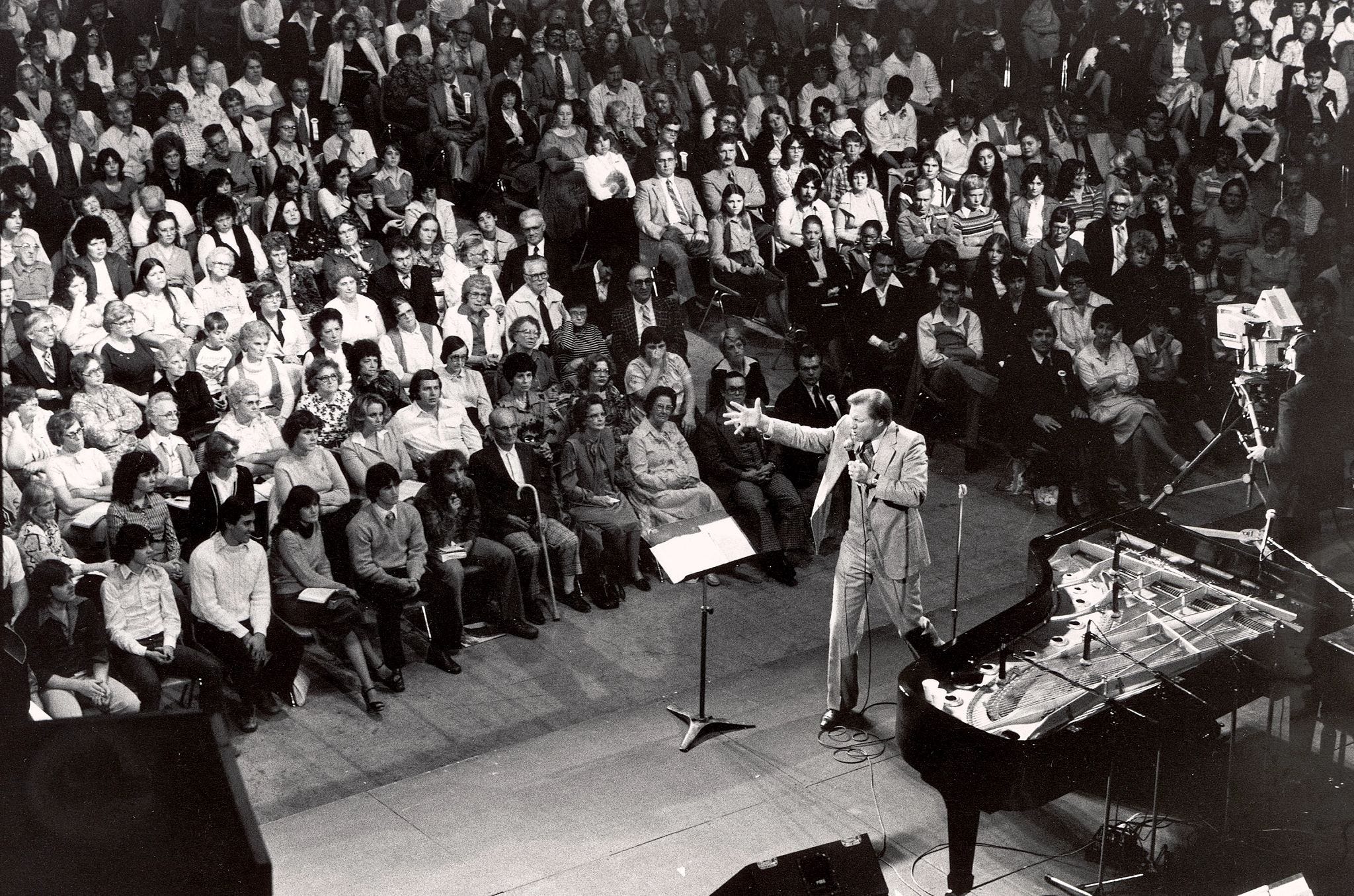
Swaggart, like his cousin—rock & roll legend and confessed sinner Jerry Lee Lewis—“plays the piano well, sings sweetly, and uses the full range of television’s resources,”Postman says. When he really gets going, he prefers a fire-and-brimstone approach, but he tones it down for the TV audience. The sermon in question, in this case, is, “Are the Jews practicing blasphemy?” Swaggart assures his audience that the answer is no, and in any case, some of them are pretty nice people.
It is the perfect television sermon—theatrical, emotional, and in a curious way comforting, even to a Jewish viewer. For television—bless its heart—is not congenial to messages of naked hate. For one thing, you never know who is watching, so it’s best not to be wildly offensive.
This is almost quaint. Compare Swaggart’s sermon to the wildly offensive antisemitism of Candace Owens, who knows exactly who is watching. Or Nick Fuentes, who berates his own America First audience on Rumble for being the “stupid” strain of antisemite, the klansman in a funny hat, compared to his enlightened version of naked hate.
For all the campy theatrics, the voiding of authentic religious experience, I can’t help noticing that Postman’s chapter on TV religion skirts another mass medium, for which Postman seems to have no real appreciation: rock & roll. It seems to be lurking around the edges of the Electric Church, suggesting a better alternative.
Swaggart, as mentioned, was Jerry Lee Lewis’s sanctified doppelgänger. Another Sun Records artist, Johnny Cash, was intimate friends with Billy Graham—Graham even convinced the Man in Black to write an historical novel, Man in White, about the life of St. Paul. Long before televangelism, “the Electric Church” was Jimi Hendrix’s term for an artistic and spiritual philosophy: using loud, electrified music to awaken listeners’ souls. And as everybody knows, the devil’s music was born of the pentecostal choir.
Elvis, another Sun Artist, learned to sing in church, and frequently employed gospel singers. Especially in Las Vegas, a city which “proclaims the spirit of a culture in which all public discourse increasingly takes the form of entertainment,” Postman says. “A “metaphor of our national character and aspiration.”
Sure beats Palo Alto.
At any rate, Postman doesn’t blame his spiritual messengers—even the ones who proved to be frauds and embezzlers. He blames the medium.
Perhaps we’d all be better off listening to church, spiritual or secular.
Electric Education
Postman, as I said, doesn’t have a special place in his heart for rock & roll.
He mocks, an “experiment in Philadelphia in which the classroom is reconstituted as a rock concert,” and derides the, “English teacher who asks [students] to learn the eight parts of speech through the medium of rock music.”
I had to laugh, and think of Jack Black in School of Rock.

What Postman is getting at, though, is the idea of education as entertainment. You might call him Oscar the Grouch, when it comes to Sesame Street. After reading what he has to say about this popular children’s program, the Department of Education, and PBS’s approach to pedagogy, you might agree.
This was the moment when electronic media supplanted reading, writing and rhetoric in the classroom.
The Voyage of the Mimi
A multi-media teaching program called The Voyage of the Mimi, a 26-series TV show that aired on PBS about a fictional crew of marine biologists aboard a whaling research vessel, was introduced to public-school classrooms in 1984. Mimi was sponsored by the Department of Education (funded by a $3.65 million grant), a major publishing firm, and the Bank Street College of Education. The TV show was supplemented by a series of book and computer exercises designed to teach “computer literacy.”
Frank Withrow, of the Department of Education, had this to say about The Voyage of the Mimi: “We consider it the flagship of what we do. It is a model that others will begin to follow.” It is also “cheaper than anything else we do,” Mr. Withrow added. “With Sesame Street, it took five or six years, but eventually you can start bringing in the money with T-shirts and cookie jars.”
Unlike our current Secretary of Education, at least Mr. Withrow wasn’t a former executive for World Wrestling Entertainment.
Aside from the Department of Education focusing on Mimi money and Cookie Monster merch, Postman takes aim at parents who embraced Sesame Street because it assuaged their guilt that, “they could not or would not limit their children’s” screen time.
And at educators, who were apt to find these new methods congenial, especially if “education can be accomplished more efficiently by means of the new techniques,” and less time and effort from teachers.
That is why, “standardized tests, and, now, micro-computers have been welcomed into the classroom,” Postman wrote over forty years ago.
Computerized Learning and Standardized Tests: i-Ready and MAP
Which brings me to an UnHerd article I read this week, about the “new model” of education Postman saw emerging in 1985: “The plot to replace teachers with tech: The popular i-Ready platform dulls young minds.”
“Marketed as a high-tech solution to lagging test scores on government-mandated tests, i-Ready is used across 30-plus states and a staggering 70% of the top-100 school districts, covering nearly half of elementary and middle-school children.” Last year, it was hit with a class-action lawsuit charging that, “the platform is less about e-learning than its data-extraction racket exploiting minors without parental consent,” tracking not only students’ learning aptitude but the “names, birthdays, and racial backgrounds” of its 14 million “users.” i-Ready makes more than $750 million in annual revenue, part of a $94 billion ed-tech market in 2026—“derived overwhelmingly from America’s taxpayer-funded public schools.”
i-Ready is a two-tier product: i-ready Inform, the diagnostic half, delivers standardized “adaptive tests” given three times per subject annually; i-Ready Learning turns each student’s test scores into algorithmically generated lessons, in the form of gamified questions delivered by “infantile cartoon characters with names like ‘Yoop Yooply’ and ‘Snargg.’”
Not even the imagineer of the Orgy Porgy and Bumble Puppy, Huxley, could compete with these names.
According to UnHerd, i-Ready is “a vector of almost Orwellian surveillance.” One West Virginia teacher, who asked to remain nameless, reported that he was reprimanded after a school administrator noticed his students weren’t clocking the minimum i-Ready minutes per week. “Teachers at my school are worried… There’s absolute fear,” he said, of being fired and surveilled.
One Massachusetts math and technology teacher, who quit after his school mandated that he increase the use of i-Ready to 60% of his class time, explained that i-Ready Inform tests had informed him his students were unable to solve basic geometry problems. The software, “was telling me my kids were completely ignorant,” while the teacher knew from experience they had mastered the Pythagorean Theorem. In response, UnHerd writes, his “students gamed or rushed through the diagnostics, generating incorrect scores that then locked them into weeks of needlessly remedial lessons.”
While clearly aiming to entertain, with cartoon-character names like Yoop Yooply and Snargg, students are not amused.
Postman worried that students “have learned that learning is a form of entertainment or, more precisely, that anything worth learning can take the form of an entertainment.” But UnHerd worries that, “When students are mandated to spend hours each week using a tool they actively detest, it trains them to equate schoolwork with coercion and monotony.”
My own son’s school district uses i-Ready in K-5 classrooms.
They also use the Measure of Academic Progress (MAP) testing program, developed by NWEA—a computerized test administered three times a year to measure proficiency in Math, Language Usage, and Science, in which the questions get easier if students answer them incorrectly, targeting a mediocre 50% correct rate.
You can’t even find what NWEA, the maker of the MAP test, stands for on NWEA’s website, but it’s the Northwest Evaluation Association, a division of publishing giant Houghton Mifflin Harcourt, now owned by Veritas Capital.
The precursor to Houghton Mifflin once published the works of such luminaries as Ralph Waldo Emerson, Nathaniel Hawthorne, and Henry David Thoreau. Harcourt published the works of T.S. Eliot, Virginia Woolf, Sinclair Lewis, and… George Orwell. Now it’s a conglomerate owned by a private equity firm hawking computerized tests.
The administrative directive to use computerized learning all comes down to funding, a lack of teachers and time, and standardized test scores. In other words, it all comes down to data and numbers.
As Postman said in 1985, both naively and presciently:
Although I believe the computer to be a vastly overrated technology, I mention it here because, clearly, Americans have accorded it their customary mindless attention; which means they will use it as they are told, without a whimper. Thus, a central thesis of computer technology—that the principal difficulty we have in solving problems stems from insufficient data—will go unexamined. Until, years from now, when it will be noticed that the massive collection and speed-of-light retrieval of data have been of great value to large-scale organizations but have solved very little of importance to most people and have created at least as many problems for them as they may have solved.
Protest School
Whether or not Sesame Street, The Voyage of the Mimi, MAP or i-Ready teaches kids their numbers and letters, or factoids about whale migration and marine navigation, or increases data-driven test scores, is irrelevant to Postman.
“As John Dewey,” the educational reformer, said, “the content of a lesson is the least important thing about learning . . . In other words, the most important thing one learns is always something about how one learns. As Dewey wrote in another place, we learn what we do.”
I’ll tell you another story about my kid’s school. In January, between the deaths of Renee Good and Alex Pretti, my son was marked absent from sixth period. When asked why, he replied that he’d participated in a school-wide walk-out. The first of several, in response to recent events.
A protest, chaperoned by teachers, who were present for “safety.” In subsequent walk-outs, after teachers were reminded that public educators cannot express political or religious views during school hours, the kids were left to their own devices. Some wandered down the busy boulevard adjacent to the school, peppered with homeless encampments and possibly, ICE agents patrolling the city.
School walk-outs are more common than field trips at Portland Public Schools, so I was barely fazed. I also surmised the cause of the walk-out, though that too was irrelevant. I’d venture that approximately 100% of seventh graders would participate in a walk-out to protest the earth moving around the sun, if it meant skipping sixth period. “What did you guys do during the walk-out,” I asked?
“We chanted,” he said.
“What’d you chant?”
“We chanted, ‘F’ ICE.”
“You mean you chanted ‘F’ ICE, or you chanted Fuck ICE?”
“The second one.”
This is learning by doing, in 2026. Reciting meme slogans that even Renee Good was too polite to utter, before she was shot by an ICE agent filming her death on a cameraphone.
Electric Orwell
While i-Ready might not be as amusing or educational as Sesame Street, the “micro-computers” Postman saw creeping into classrooms have still made students, “well prepared to receive their politics, their religion, their news and their commerce in the same delightful way,” through the smartphone.
As Postman saw about the technology of his day:
[T]elevision is altering the meaning of “being informed” by creating a species of information that might properly be called disinformation. I am using this word almost in the precise sense in which it is used by spies in the CIA or KGB. Disinformation does not mean false information. It means misleading information—misplaced, irrelevant, fragmented or superficial information—information that creates the illusion of knowing something but which in fact leads one away from knowing. […] I do not mean to imply that television news deliberately [does this]. I mean to say that when news is packaged as entertainment, that is the inevitable result.
Disinformation, especially with regard to online news, has been the subject of much debate in the 2020s. The so-called “Disinformation Industrial Complex,” or “Censorship Industrial Complex”—a term coined by one journalist who’s turned out to be quite misinformed himself (Michael Shellenberger) and another who’s not (Matt Taibbi)—was the subject of 2023 congressional hearings and a 2024 Supreme Court case.
The news story—the so-called Twitter Files—about a complex of NGOs, university research departments, and government agencies working together to suppress information on social media, at Elon Musk’s insistence, was first reported by Taibbi in a series of tweets. I can’t imagine what Postman would have to say about the concept of Twitter News, given his thoughts on TV News.
Actually, I can. In response to the advent of USA Today, a daily newspaper that began packaging itself as TV news in print in 1982, Postman had this to say:
In the age of television, the paragraph is becoming the basic unit of news in print media. . . . As other newspapers join in the transformation, the time cannot be far off when awards will be given for the best investigative sentence.
As far as I know, no one has received an award for the best investigative tweet. But in December 2025, Vice President J.D. Vance congratulated a pseudo-literate YouTuber named Nick Shirley for his investigative reporting on Somali daycare fraud in Minneapolis (a real story, mangled by Shirley’s misplaced, irrelevant, fragmented and superficial reporting), in an X post stating that: “This dude has done far more useful journalism than any of the winners of the 2024 @pulitzercenter prizes.”
Here’s the Vice President’s paragon of Pulitzer prize-worthy journalism, trying to pronounce the word “benevolent,” and what it means.
About “freedom of information,” Postman wrote, “Orwell, quite reasonably supposed that the state, through naked suppression, would control the flow of information.” Certainly, this was “the way of the Soviet Union” in 1985, and remains the case in places like modern-day Russian, North Korea, China, and Iran.
But there was no Orwellian Ministry of Truth in America, Postman believed: “The President does not have the press under his thumb. The New York Times and The Washington Post are not Pravda; the Associated Press is not Tass. And there is no Newspeak here. Lies have not been defined as truth nor truth as lies. All that happened is that the public has been amused into indifference.”
He’s right, and wrong. The President doesn’t quite have The New York Times under his thumb, but he has sued it, and 60 Minutes, and put pressure on broadcast networks, universities, law firms and other institutions. Lies have been defined, or at least claimed, as truth.
Even if, as Postman says, “In America, the least amusing people are its entertainers”—its opinionated Oscar and Grammy nominees and talk-show hosts—and, “the value of its news is determined by the number of laughs it provides,” as Postman also said, predicting a wave of talkshow clapter… there is something Orwellian about trying to get Jimmy Kimmel fired for protected speech. Even if the speech that got Kimmel temporarily canceled was itself disinformation.
What’s indispensable about Orwell for Postman is that it makes no difference whether suppressors are, “inspired by left-wing or right-wing ideologies. The gates of the prison are equally impenetrable, surveillance equally rigorous, icon-worship equally pervasive.”
Postman was right about Huxley’s implication that, “seemingly benign technologies devoted to providing the populace with a politics of image, instancy and therapy may disappear history just as effectively, perhaps more permanently, and without objection,” than Orwell’s Ministry of Truth.
2020s tweets and TV shows about Nikole Hannah-Jones’ “1619 Project,” and the Trump administration’s counter “1776 Commission”—dubious revisions of history that redefined the foundations of American democracy as either: an irredeemable pedestal of patriarchy, slavery, and white supremacy, or: unqualified Greatness—have disappeared and distorted history. But the latter was more Orwellian, sponsored by our own government, unlike the Huxleyan “1619 Project” sponsored by The New York Times and Hannah-Jones’ obnoxious tweets.
There is definitely something Orwellian about the “1776 Commission,” and the online surveillance reported in the Twitter Files at the end of the Biden era. Not to mention the European Union’s Digital Services Act, and the United Kingdom’s Online Safety Act.
And this—the head of President Biden’s proposed Disinformation Governance Board, “Disinformation Czar” Nina Jankowicz—is both Orwellian and Huxleyan. Teaching Americans about disinformation, by singing (like Mary Poppins).
The Disinformation Governance Board was quickly discarded, once Americans compared it to the Ministry of Truth. Despite Jankowicz’s Huxleyan delivery, Americans were, and were not, amused.
The Disinformation Czar was laughed out of existence. That’s reassuring, and concerning, after reading Postman:
Tyrants of all varieties have always known about the value of providing the masses with amusements as a means of pacifying discontent. But most of them could not have even hoped for a situation in which the masses would ignore that which does not amuse. Censorship, after all, is the tribute tyrants pay to the assumption that a public knows the difference between serious discourse and entertainment—and cares. How delighted would be all the kings, czars and führers of the past (and commissars of the present) to know that censorship is not a necessity when all political discourse takes the form of jest.
[italics mine]
Infinite Jest
Amusing Ourselves to Death was reportedly one of the texts found on David Foster Wallace’s bookshelf after the author of Infinite Jest took his own life in 2008.
Like Huxley’s Brave New World, Wallace’s Infinite Jest is set in the future. A future where time itself has been subsidized—most of the novel takes place in the “Year of the Adult Depend Undergarment (YDAU), which is generally assumed to be around 2009. Brave New World is also set in a year named after a corporation—the year 632 A.F. (“After Ford”).
The Macguffin in Infinite Jest (like the brief case in Pulp Fiction—the coveted device that drives the plot) is a lethally addictive underground film, variously known as “the Entertainment,” the “Infinite Jest,” and the “samizdat.” The latter is a Soviet term for censored material, more appropriate to the world of Orwell than Huxley.
Viewers of the illicit “Entertainment” in Infinite Jest become so transfixed by it that they lose all desire to do anything but watch it, leading to death by amusement, drooling themselves into apathy and starvation.
You know, TikTok.
Which, like Wallace’s samizdat, is outright banned or restricted in nine countries, said to be quite addictive, and alleged to be a weapon of cultural destruction (in Infinite Jest, it is Canada, not China, who wants to deploy “the Entertainment” against the United States).
Wallace was a recovered substance abuser and, even in his later sobriety, a confessed television addict. In the 2015 biopic about his reluctant ascent to celebrity in the wake of Infinite Jest, Wallace (played by Jason Segel) explains to Rolling Stone reporter David Lipsky (played by Jesse Eisenberg), that in 1996, he doesn’t own a TV—“if I had one, I would watch it all day.” “My primary addiction in my entire life,” Wallace tells Lipsky, “has been to television.”
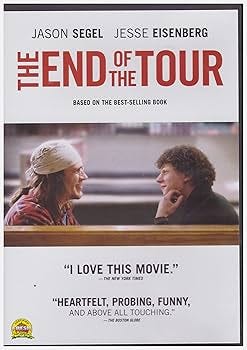
He compares TV to junk food, which sounds a lot like “the Entertainment” in his novel:
...it’s gonna get easier and easier... and more and more convenient and more and more pleasurable... to sit alone with images on a screen... given to us by people who do not love us but want our money. And that’s fine in low doses, but if it’s the basic main staple of your diet, you’re gonna die. In a meaningful way, you’re going to die.
As Postman said, about death by distraction:
When a population becomes distracted by trivia, when cultural life is redefined as a perpetual round of entertainments, when serious conversation becomes a form of baby-talk, when, in short, people become an audience and their public business an act, then a nation finds itself at risk; culture-death is a clear possibility.
In a 1996 interview on Boston’s WBUR radio program The Connection, the real David Foster Wallace responded to host Christopher Lydon’s observation that, “All the reviewers [of Infinite Jest] make some reference to the title of Neil Postman’s book, Amusing Ourselves to Death. That does seem to be one of the main metaphors of the society and of the book, is it not?”
Wallace responded:
To an extent, although really [Infinite Jest] is strategically set in the future. It’s not really supposed to be a reflection of the way things are now but a kind of extrapolation on trends. I remember seeing Terry Gilliam’s Brazil, where everybody has TVs coming on rods out of their foreheads and everybody’s watching TV all the time… it’s not quite that. When you think about how first HDTV’s going to come, then there’s going to be virtual reality, and then there’s the prospect of things like virtual reality porn… we’re going to have to come to some sort of understanding about how much we’re going to allow ourselves, because it’s probably going to get a lot more fun than real life.
Coincidentally, I happened to find myself in the trendy Pearl District of Portland last weekend, where images from a film were being projected, without sound, out of context, inside a hipster bar. I vaguely recognized the noire-ish, fragmented shadows on the wall behind the bottles of alcohol, but I couldn’t quite place them: the images kept distracting me from conversation with the people around me. I realized, when stormtroopers from the Ministry of Information burst into a love scene (taking place behind our bartender, manically shaking cocktails): it was Terry Gilliam’s Brazil.
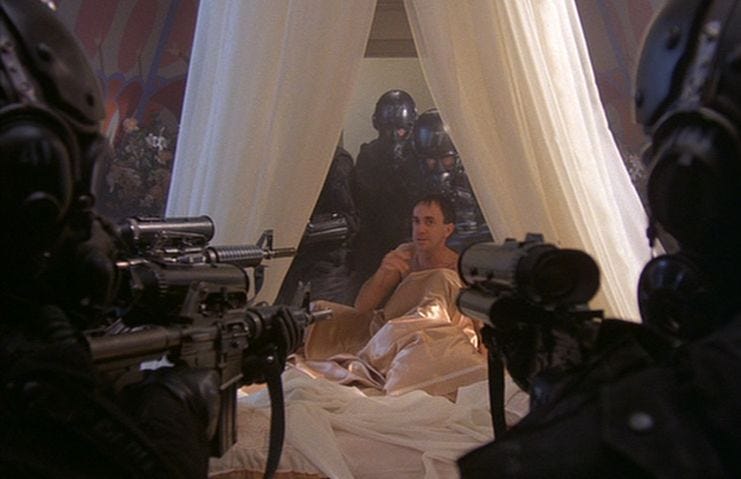
The host of WBUR made another observation, popular in 1996: that the internet would actually save us from the culture Wallace feared:
Then there’s the other thought that I tend to subscribe to, that broadcast television is already dead, and that the new world of interactive media, the Internet world, is a counter to that and not an extension.
Wallace, always humble, was dubious, and prescient:
The idea, though, that improved technology is going to solve the problems that the technology has caused seems to me to be a bit quixotic. I understand that there’s a certain amount of hope about the Internet democratizing people and activating them. The fact of the matter is that it seems to me if you’ve still got a nation of people sitting in front of screens interacting with images rather than each other, feeling lonely and so needing more and more images, you’re going to have the same basic problem. And the better the images get, the more tempting it’s going to be to interact with images rather than other people, and I think the emptier it’s going to get. That’s just a suspicion and just my own opinion.
I wonder what the guy who described Brazil—released in 1985, the same year as Amusing Ourselves to Death—as a film about a totalitarian state where people have “TVs coming on rods out of their foreheads,” would have to say about selfie-sticks and GoPros. And ICE agents and protestors using them to film law-enforcement encounters.
Electric Junk
Postman and Wallace both referred to television as junk, a word that denotes both addictive food, and narcotics. In addition to being a novel about addictive entertainment, much of Infinite Jest takes place in Twelve-Step meetings and rehab facilities.
In 1992, ethnobotanist Terence McKenna wrote, in Food of the Gods: The Search for the Original Tree of Knowledge that, "Television is by nature the dominator drug par excellence. Control of content, uniformity of content, repeatability of content make it inevitably a tool of coercion, brainwashing, and manipulation."
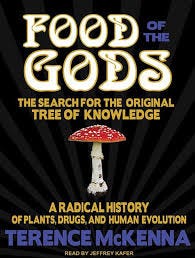
McKenna argued that hallucinogens like psilocybin, the “food of the gods,” could provide spiritual insight and be used to treat PTSD, alienation, and addiction—a claim that has gained traction in recent years. I wonder what he would make of the “psilocybin therapy” advertised on Instagram.
Of course, some would argue that hallucinogens can also be, as McKenna said of TV, their own “tool of coercion, brainwashing, and manipulation.” Charles Manson fed his cult followers LSD before he brainwashed them into murdering nine people—among them a Hollywood actress married to a famous director, a celebrity hairstylist, and an aspiring screenwriter.
In Quentin Tarantino’s fictional reimagining of the Mansons in Once Upon a Time in Hollywood (2019), “Sadie,” a stand-in for Manson member Susan Atkins, explains the Manson family’s twisted logic, which she developed during one of her “trip sessions”:
Dig it! We all grew up watching TV. You know what I mean? If you grew up watching TV, that means you were watching murder. Every show on TV that wasn't I Love Lucy was about murder. So my idea is: we kill the people who taught us to kill. I mean, where the fuck are we, man? We are in fucking Hollywood, man!

Another film about junk, Drugstore Cowboy (1989), featuring the author of Junkie, William S. Burroughs, also makes the analogy between narcotics, TV and violence explicit. As “Bob,” an addict played by Matt Dillon opines on the younger generation raised on television: "All these kids, they're all TV babies. Watching people killing and fucking each other on the boob tube for so long it's all they know. Hell, they think it's legal. They think it's the right thing to do."

At the end of Drugstore Cowboy, a reformed Bob, now in recovery, is shot by a teenage junkie he used to know, during a robbery. As he’s loaded into an ambulance, possibly on his way to die, the narcotics detective who once chased Bob asks him who did it. “The TV baby shot me,” are Bob’s last words.
Today, we worry a lot about “screen addiction,” the “dopamine hit” of scrolling a feed akin to gambling on a slot machine. As I write, Meta is facing a landmark lawsuit accusing its platforms, specifically Facebook and Instagram, of this very thing. (TikTok and Snapchat have already settled with the same complainant out of court.)
We also talk about impressionable people, young and old, radicalized to violence by video games and social media.
We talk a lot about “digital detox,” and “users” taking a break from the screen. This form of rehabilitation is as old as television.
Postman describes a “TV Turnoff” sponsored by the Connecticut Library Council in 1984, encouraging people to “stop watching television for one month.” As one woman, whose family participated in the TV Turnoff, explained to The New York Times, the campaign against screen time received “terrific media coverage.”
“In other words,” Postman dryly notes about this woman’s optimism, “Ms. Babcock hopes that by watching television, people will learn that they ought to stop watching television.”
We face the same irony with the modern version of the TV Turnoff. “Anti-social media” and “digital detox” influencers, content creators like Olivia Yokubonis (whose YouTube channel is called “Olivia Unplugged”), Gianna Biscontini, Matt D’Avella, Essena O’Neill, advocates of a “Chronically Offline” lifestyle, hope that by using social media, people will learn that they ought to stop using social media.
The Medium is the Metaphor
The truth is, the equation of communications technology with “drugs” is as old as Athens. As Jacques Derrida explained in “Plato’s Pharmacy” in 1968, in the Phaedrus (370 BC), Plato refers to the written word as a pharmakon—a Greek word for drug that means both “poison” and “cure.” An external remedy that both aids memory, and destroys one’s capacity for inner contemplation, along with their ability to argue eloquently in person.
Postman alludes to the same story as Derrida and Socrates in Plato’s Phaedrus: an ancient myth about how writing was brought to the Egyptians, and later, Greeks. A kind of technological “magic.”
Anthropologist know that the written word . . . is another kind of voice altogether, a conjurer’s trick of the first order . . . the Egyptian god Thoth, who is alleged to have brought writing to King Thamus, was also the god of magic.
King Thamus, for what it’s worth, worried that writing would cause people to stop using their memories and "hear many things without being properly taught," a philosophical critique implying that the creators of magical new technologies, like Sam Altman, like the god Thoth, are not always the best judges of the their utility—a critique of writing (and OpenAI) echoed by Plato.
Plato, of course, jotted this whole conversation between Socrates and Phaedrus down on a scroll of papyrus or a wax tablet, and the only reason I can tell you about it today is because I jogged my grad-school memories of “Plato’s Pharmacy” and the Phaedrus with a search engine powered by Google’s Large Language Model, Gemini.
Pharmakon. “Poison” and “Cure.”
After this allusion to Plato’s Phaedrus, Postman explains, “I bring all this up because what my book is about is how our own tribe is undergoing a vast and trembling shift from the magic of writing to the magic of electronics . . . a transformation of his way of thinking—and, of course, of the content of his culture. And that is what I mean by calling a medium a metaphor.”
Marshall McLuhan claimed “the medium is the message.”
Postman amends McLuhan to say “the medium is the metaphor”:
A message denotes a specific, concrete statement about the world. But the forms of our media, including the symbols through which they create conversation, do not make such statements. They are rather like metaphors, working by unobtrusive but powerful implication to enforce their special definitions of reality.
Whether we mediate the world through the lens of speech or writing, TV or TikTok, “our media languages classify the world for us, sequence it, frame it, enlarge it, reduce it, color it, argue a case for what the world is like.”
We are told in school, quite correctly, that a metaphor suggests what a thing is like by comparing it to something else. And by the power of its suggestion, it so fixes a conception in our minds that we cannot imagine the one thing without the other: Light is a wave; language, a tree; God, a wise and venerable man; the mind [as in the allegory of Plato’s cave], a dark cavern illuminated by knowledge. And if these metaphors no longer serve us, we must, in the nature of the matter, find others that will. Light is a particle; language, a river [the “stream of consciousness” in modernist writing]; God (as Bertrand Russell proclaimed) a differential equation; the mind, a garden that yearns to be cultivated.
What are our metaphors, in 2026?
Light is a pixel; language, a Large Model, or meme (conversation, a thread). God is Artificial Super Intelligence (perhaps Bertrand Russell was right, but he should’ve substituted “algorithmic” for “differential” equation). The mind—consciousness—a “black box.”
The entire universe, a Simulation. Reality, virtual. Rationality is “thinking logically like a computer.” Altruism is “Effective”—the accumulation of personal wealth for the supposed benefit of others. Intelligence is artificial. Media is social. The afterlife a digital Mind Clone. The world a Web. The individual, identity. Politics, performance. Culture, a “war.” Information is intubated down our throats on “Feeds.” Notifications “push” us. Sound is a byte. Image a clip. Phones are smart. Laptops top our laps. People pool in pods, and are cast to, like human fish in the natal “hatchery” at the beginning of Brave New World. Meetings and learning are “remote,” and speed-of-light—Zoom! Psychological profiles are Hogwarts houses and Zodiac signs. Sex is a construct. Every customer a “user,” and every half-baked dipshit a “creator” of “content.” A cult-like “influencer” with “followers.” Information is a disease, “viral.” I could on.
As Ernst Cassirer remarked in An Essay on Man (1956): “Physical reality seems to recede in proportion as man’s symbolic activity advances.”
Like Plato, Postman explains media in terms of myth, in the way Roland Barthes uses the word: “a way of understanding the world that is not problematic, that we are not fully conscious of, that seems, in a word, natural. A myth is a way of thinking so deeply embedded in our consciousness that it is invisible.”
“We do not see nature or human motivation or ideology as ‘it’ is,” Postman said, “but only as our languages are. And our languages are our media. Our media are our metaphors. Our metaphors create the content of our culture.”
Most of us, as José Ortega y Gasset said in Revolt of the Masses (1930), have no idea how the technology that runs our lives works. We are like primitives, taking it for granted that, like fire, tech is natural magic handed down to us by godlike inventors. Even the elite engineers at Anthropic have no idea how their LLM works, that’s why they call it a black box.
Postman asks a host of questions about the psychic, political and social effects of technology, to try to “break the spell” of media, which, he adds, “are as applicable to the computer as to television.” Only through a “deep and unfailing awareness of the structure and effects of information, through a demystification of media, is there any hope of our gaining some measure of control over television, or the computer, or any other medium.”
Questions like, “What is information? Or more precisely, what are information? What are its various forms? What conceptions of intelligence, wisdom, and learning does each form insist upon?” Do they give “a new meaning to ‘piety,’ ‘patriotism,’ and ‘privacy’?”
His son Andrew asks similar questions, in the Introduction to his father’s book: “Do they degrade democracy? Do they make our leaders more accountable or less so? Our systems more transparent or less so? Do they make us better citizens or better consumers?”
“These questions,” the elder Postman wrote, “and dozens more like them, are the means through which it might be possible for Americans to begin talking back to their television sets, to use Nicholas Johnson’s phrase.”
Yikes.
“Talking back to our television sets” sounds like the definition of chatbots and social media.
In any case, they seem to have degraded democracy, made us worse citizens, made our leaders and systems both more transparent and less accountable. And they have certainly redefined piety, patriotism, and privacy.
The Medium is the Ideology
According to Postman, in his final “Huxleyan Warning,” there are two ways in which a culture dies: “In the first—Orwellian—culture becomes a prison. In the second—Huxleyan—culture becomes a burlesque.”
[W]hat is happening in America is not the design of an articulated ideology . . . It comes as the unintended consequence of a dramatic change in our modes of public conversation. But it is an ideology nonetheless, for it imposes a way of life, a set of relations among people and ideas, about which there has been no consensus, no discussion and no opposition. Only compliance. Public consciousness has not yet assimilated the point that technology is ideology.
What Postman didn’t see foresee was a nation whose parental generations (Boomers, X-ers) were trained on the TV commercial, whose progeny (and themselves) would become engaged in making their own personalized versions of instant TV commercials on social media.
Introduce speed-of-light transmission of images and you make a cultural revolution. Without a vote. Without polemics. Without guerrilla resistance. Here is ideology, pure if not serene. Here is ideology without words, and all the more powerful for their absence. All that is required to make it stick is a population that devoutly believes in the inevitability of progress. And in this sense, all Americans are Marxists, for we believe nothing if not that history is moving us toward some preordained paradise and that technology is the force behind that movement.
Introduce speed-of-light transmission of images into the hands of every citizen and you also have a cultural revolution. With a vote and polemics—by virality. With a guerrilla resistance—by mimesis. With a cabal of transhuman AI-optimists moving us toward some preordained paradise driven by their own technological force.
This is both serious and trivial, amusing and deadly—think of the people shot and arrested by ICE, and think about the way it was communicated and explained to us. Think about the revolutions in Peru, Bangladesh, Morocco, Madagascar, Nepal, and Bulgaria, organized on the gaming platform Discord, which I wrote about recently and Martin Gurri describes as Generation Z Tearing Down Entire Nations.
In the final paragraph of Amusing Ourselves to Death, Postman writes that, like futurist-fiction writer H.G. Wells, Huxley believed we were in a race “between education and disaster.” Both, Postman wrote, were convinced of the necessity of understanding “the politics and epistemology of media.”
What afflicted the citizens in Brave New World, the final sentence of Amusing Ourselves to Death goes, “was not that they were laughing instead of thinking, but that they did not know what they were laughing about and why they had stopped thinking.”
For those of you with young children, ask them what the meme “6-7” means. They will laugh, and tell you they have no idea.

Are you Tulsa-based?
what do you disagree with me on (will read whole piece after i run errands, this looks awesome)
🥺🥺🥺