Third Ear, Third Year
Best of the worst: anniversary edition

Dear faithful few,
Sunday—the Ides of March—marks the third anniversary of The Third Ear.
That’s right. I’ve been pestering you people with my perambulations through philosophy and culture for three trips around the sun.
Which means, it’s time to exercise some bragging rights. What humble few I have.
Substack is quite good at providing statistical ‘content’ analysis—I know who’s actually reading this, when, where, how often, etc.
So I thought I’d remind readers (and lurkers) of a few of my more-popular pieces from the past, to celebrate the beginning of year four.
In case you missed them, the first time around.
First, I’d like to recommend a few authors, podcasters, and journalists I’ve mentioned over the years. Most of them, like myself, are liberals lost in the woods, trying to wrap their heads around the past decade-plus of culture shock. Others are simply arts and culture junkies who know their stuff—cultural historians, musicologists, etc.
I devote a sizable chunk of The Third Ear to recommending and sharing other people’s work. It’d be nice if someone would return the favor, for my little outpost of the global village.
Oh wait, somebody has…
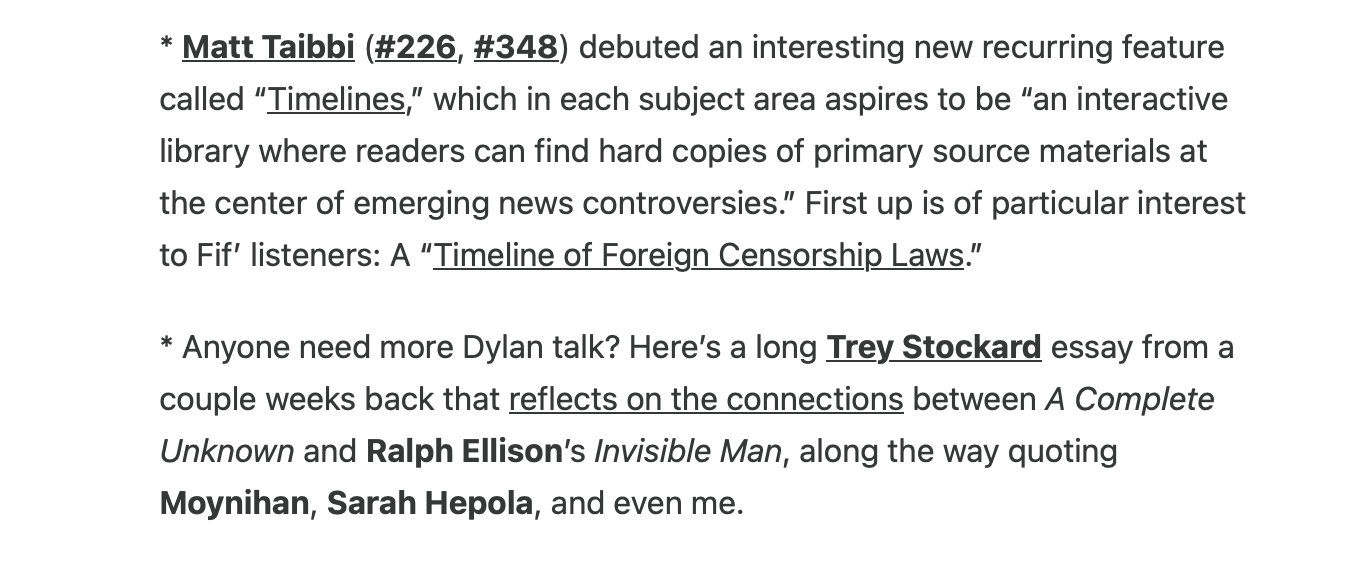
That’s The Fifth Column’s weekly recommendations letter, recommending one of my idol journalists (Matt Taibbi), and then, a complete unknown—me! Thanks, Fifth Column.
Here’s the “long Trey Stockard essay” mentioned above (4,700 words, 21 minute read), in re: James Mangold’s 2024 Bob Dylan biopic, A Complete Unknown).
What’s The Fifth Column, you ask?
The Fifth Column, a podcast (and newsletter)
I’ve mentioned these guys many times: Matt Welch, Kmele Foster, Michael C. Moynihan. All veteran journalists, some formerly “libertarian-adjacent,” all politically agnostic. If you’re not listening to them, in my opinion, you’re missing out on an epistemological guide to understanding news-media and culture.
Michael is hilarious, and along with Matt, knows (rock) music history like the back of his hand (makes for wonderful interludes, on a show nominally billed as a “weekly rhetorical assault on the news cycle, the people who make it, and occasionally ourselves”). Kmele interviewed legendary music producer Steve Albini shortly before he died, and about a billion other people. He’s also a shameless, if concerned, Kanye West fan.
As far as recent interviews go, I recommend this Fif’ episode with Gov. Chris Christie. Whatever your politics, or lack thereof, “Big Boy” (as George W. Bush nicknamed Christie) has some stories to tell about everyone inside (and outside) the beltway. Amazing, hair-raising stories.
And this episode, with Noam Dworman, owner of the Comedy Cellar in NYC. Formerly, owner of The Cafe Wha?—launchpad for Jimi Hendrix, Bob Dylan, et al.
Dworman’s Comedy Cellar is the type of place you might wander into, and happen to find that someone like Dave Chappelle, Jerry Seinfeld, or Chris Rock has also wandered in, unannounced, to test new material.
In other words, The Comedy Cellar is a haven of free expression, improvisation, and American Humor.
The Holy Trinity of The Third Ear.
Speaking of free expression, improvisation, and American Humor…
My most-read (or opened) piece:
8,000 words, in which I attempt to flirt (in print) with an attractive “Dylanologist” (Bob Dylan expert) at the Tulsa Switchyard’s “World of Bob Dylan” conference. By lecturing her on the sordid history of love songs, chivalric romance, carnival and minstrelsy. And grotesque humor. An attractive Dylanologist, who turned out to have a girlfriend.
Gotta laugh at that.
Includes the history of Church Studio, Shelter Records, Tulsa natives (and Native Americans), and my general philosophy of laughter:
“American Humor” pairs well with another popular article about Tulsa.
Specifically, a tour of Teresa Knox’s Church Studio (formerly Leon Russell’s Shelter Records, formerly a Native acting and rehab facility, formerly Tulsa’s first interracial chapel—formerly a lot of things):
Smoke ‘Em If You Got ‘Em, podcast, by Nancy Rommelmann and Sarah Hepola
I mention one half of the Smoke ‘Em crew, Nancy Rommelmann, quite often.
That’s because, like yours truly, she lived in Portland for many years (and once, I’m told, dated Eddie Vedder—which, to be clear, I have not).
Like me, Nancy also has roots in Tulsa (where my mother’s family’s from).
Unlike me, Nancy has roots in Tulsa Indian culture—her daughter Tafv was the set designer for Reservation Dogs, and now The Lowdown (starring Ethan Hawke, who also spends a lot of time in Tulsa). Two TV series set in Oklahoma, created by Tulsa and Muskogee Native director Sterlin Harjo.
Tafv Sampson is the product of Nancy’s marriage to Tim Sampson (rest in peace), a Native actor and the son of Will Simpson—the man who played “Chief,” in One Flew Over the Cuckoo’s Nest, another Oklahoman.
Nancy’s coverage of Portland during the 2020s protests, like her recent coverage of Portland ICE protests, and her writing about Portland in general, is stellar and even-handed. Also, she risks her butt out there to get the story. I’ve seen it (the risk, not her butt).
Most recently, for this article, at RealClear Investigations.
Nancy even inspired me to apply for one of these (see below), as an excuse to present myself as a credentialed journalist, covering the Portland ICE protests last October:
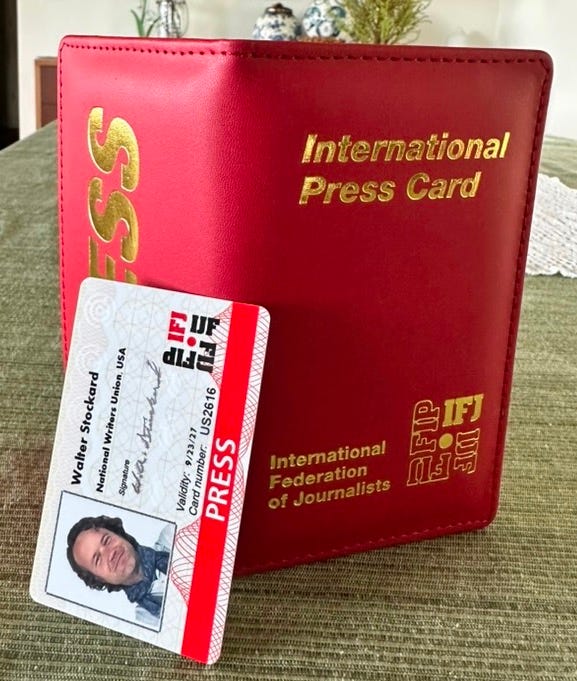
If the IFJ press card looks a little like Mao’s Little Red Book… well, there’s probably a reason for that. The International Federation of Journalists, shall we say, is not politically neutral. I learned that after I became a member. I'll let you guess which way they lean, hard.
But hey, a press pass is a press pass. It gets me into places, and I didn’t even have to flash it in order to meet Nancy Rommelmann in person, who quotes me as a fellow reporter, in her Portland ICE article above.
(NB: I am “another reporter” who says, “It’s like the internet come to life”—not the guy stinking of booze she mentions in the next clause. Don’t want people getting the wrong idea.)
I do my drinking after I get pepper-balled by ICE.
I connected with Rommelmann when I wrote the story of her Portland cancelation, and the shuttering of her former husband’s coffee chain, weaving in Nancy’s singular reporting on the shadier side of #MeToo, which involves a literary hoax and some sketchy actors who became stalwarts in the movement.
If you haven’t read her, or me, you probably don’t know about director Asia Argento’s relationship with celebrity food-writer Anthony Bourdain, their role in #MeToo, and how it all ended in farce and tragic suicide.
I cover scapegoating and mimetic behavior quite a bit at The Third Ear; this story was a perfect tie-in.
Here’s the article about Nancy, #MeToo, scapegoating, Tony Bourdain, celebrity lit hoaxes, et al:
I tagged Nancy in the article above, and she was kind enough to read all 5,000 words of it, enjoyed it, and made a nice video about it, below.

She also named The Third Ear her “new favorite Substack,” and for a while, became a subscriber.
(She’s since unsubscribed, but I’ll forgive her ‘cause she’s a busy lady. Who doesn’t have time to clutter her email with 10,000-word articles about medieval romance, or media theorists).
Speaking of 10,000 word articles about media theorists…
Last week, I published an article about Neil Postman’s Amusing Ourselves to Death, “Smoke Signals.”

It hasn’t quite passed the threshold of “most read” articles (a number so low I will not reveal the arbitrary metric of said threshold)—but it hasn’t been up for long, and it is one of my longest pieces to date.
“Smoke Signals” did catch the attention of Katherine Dee, however, who said, “this looks awesome.”
A self described “internet ethnographer,” Dee is super-sharp and popular among many of the people I read and listen to on Substack; she’s fairly influential. She’s written for The New York Times, Spectator, UnHerd, Tablet, and Compact, all of which feature great writing in addition to Dee’s. You can also find her on Substack, here.
A writer for one Substack, founded by a couple of Washington Post journos (Wisdom of Crowds), called Dee, “one of the most original culture commentators of her generation,” and “Marshall McLuhan’s clearest heir … a unique voice.”
I first heard about Dee here, in an article for WoC called “No, Culture Is Not Stuck: You just can't see what it's become." In part, it’s Dee’s riposte to Ted Gioia, a musicologist and culture-critic whose work I reference often.
Dee’s argument was that culture isn’t stagnating, or dying, as Gioia worried in the pages of The Atlantic. Rather, Dee says, “art” is simply taking new forms online—for example, sketch comedy on TikTok.
I mentioned that I disagreed with Dee on a few things, in last week’s article, but that she was an astute observer of online culture.
She asked me exactly what I disagreed with her on (basically, what Ted Gioia said, about TikTok not being art). She hadn’t read the whole piece yet, she said, but she would after she finished running some errands.
I don’t know if she ever did, but “this looks awesome” was awful nice to hear from Katherine Dee.
The other half of Nancy Rommelmann’s Smoke ‘Em If You Got ‘Em podcast is journalist and author Sarah Hepola.
Sarah writes for my home-state rag Texas Monthly (I’ve lived in Portland for eighteen years, but I’m a Texan), and writes about the Lone Star state on the reg.
She linked up with Nancy after publishing “The Things I’m Afraid to Write About” in The Atlantic in 2022—when fear of professional exile was at its peak in publishing (still hasn’t exactly subsided).
Hepola’s writing also appears in New York Times Magazine, New Republic, Glamour, Slate, The Guardian, Salon, et al. (Nancy’s journalism is published all over the place too, The New York Times, Reason, etc… and you can find her columns on Substack.)
A good episode to start with the Smoke ‘Em podcast is to bum a drag off these journalists in conversation with perhaps the most-famous Native author on the planet, Sherman Alexie, in: “Sherman Alexie Wants His Scars”—you can listen to the first part, for free.
Among other things, Alexie discusses the silliness of the word “indigenous” among elite intellectuals; and the travesty of “Pretendians”—the quintessential American pastime of pretending to be Native American.
Apropos of which, a 12-minute read:
And my 13-minute apologia of “cultural appropriation” that preceded “Pretendian”:
Blocked and Reported, podcast, newsletter, by Katie Herzog and Jesse Singal
My article about Nancy’s cancelation—“Deceitful Above All Things”—would not have been possible without Katie Herzog’s intrepid reporting for The Seattle Stranger, circa 2019.
Katie covered Nancy’s ordeal, and a host of other silly cancelations in Portland I quote Katie on, in her own article about the shuttering of Rommelmann’s coffee shop, “Portland Coffee Company in Hot Water,” and several other pieces.
Katie also used to live in Portland.
Katy was writing about Nancy in 2019, recall, when to cover someone who questioned the excesses of #MeToo without calling for their head on a pike was to court social death.
Katie also wrote an article for The Stranger about detransitioners—people who underwent trans surgery or hormone therapy, and either regretted it or decided to transition back to their original gender.
Herzog didn’t say detransitioning was good or bad, she just noticed, hey, this is a thing that’s happening. But Herzog was cancelled, harassed, fled Seattle, and her gig at the Stranger, in self-exile. Famous sex-advice columnist and libertine, and erstwhile Seattle Stranger, Dan Savage, came to her defense, to no avail.
Katie launched a podcast, Blocked and Reported, with science-and-medicine journalist Jesse Singal (New York Magazine, New York Times, Atlantic, author of The Quick Fix: Why Fad Psychology Can't Cure Our Social Ills), in March of 2020. Auspicious season, that—influential.
Jesse Singal has covered transgender youth medicine, among other things, since around 2016. You can guess how popular he is with the activist crowd, and the people who ran Katie out of town for interviewing detransitioners.
The last time he came to Portland for an event (while I was out of town covering the Global Free Speech Summit at Vanderbilt, last October), the original venue Jessie booked canceled over “safety” concerns, when they found out who he was. (He rebooked at a place I like, The EastBurn.)
Blocked and Reported is nominally about “internet bullshit” (and as such, has guested Katherine Dee). It’s not for everyone (mom, I’m looking at you), but if you want to comprehend the freakier corners of the internet, which now inform reality daily—Blocked and Reported is indispensable.
Along with The Fifth Column, the first time I tuned in to Blocked and Reported, circa 2021-or-22-ish, I gasped: People still talk like this? We’re still allowed to say stuff about things?
I’m informed, by a writer who’s won accolades from PEN and Guggenheim, and (in my opinion) also runs a successful podcast, that Blocked and Reported is a “unicorn.”
Meaning that (unlike, say, The Fifth Column), Katie Herzog and Jessie Singal have no venture capital and no production team, yet manage to rake in hundreds of thousands of dollars annually in paid subscriptions, DIY.
Good for them. And one day, hopefully, good for that famous writer I mentioned who called Blocked and Reported a “unicorn.” She thinks her own podcast and newsletter (also auto-funded and self-produced) is “allergic to the algorithm.”
You can find many podcast recommendations for Blocked and Reported episodes, and for the outlets mentioned above, and more, in “The Exiles” edition of my occasional Bits and Pieces feature (below)—a semi-regular format where I recommend topical tidbits of culture: books, films, articles, or in this case, podcasts.
This Bits and Pieces was particularly popular, for some reason (less than 2,000 words, 8 minute read):

Another Bits and Pieces feature, about the plague psychology behind vampires and the undead, that was popular around Halloween (12 minutes, 2,700 words):
Bits and Pieces: Buried Alive

It’s Halloween. The bits and pieces lying around my cinematic laboratory:
The Unspeakeasy, a podcast (and multi-media side-hustle) by Meghan Daum; plus, her book.
Alright—this Third (Y)ear anniversary edition is turning into a Bits and Pieces feature of its own. So let me make but one more recommendation, then return to shameless self-promotion.
I don’t think I’m talking out-of-school here by revealing that the famous writer and frustrated podcaster mentioned above is Meghan Daum.
I discovered Meghan through Smoke ‘Em, and found she has her own podcast, The Unspeakeasy. Formerly known as, The Unspeakable.
Because the cultural revolution, samizdats, and forbidden words have attenuated, a little—The Unspeakable is now renamed The Unspeakeasy.
The Unspeakeasy, née The Unspeakable, is actually much more than a podcast. It’s also a newsletter. And… something much more complex.
It began in 2022 as a series of women’s retreats (“sanity spas”) and writer’s workshops, and online meetups, where Third-wave feminists cowed by the language-policing of Fourth-wave feminism could discuss the Things-Which-Shan’t-Be-Said.
You know, things like '“woman.”
Daum has a great female-only event coming up with Caitlin Flanagan (an exquisite essayist for The Atlantic, who grew up in the company of one of my idols, and Meghan’s—Joan Didion).
Today, Meghan offers co-ed writer’s workshops, and retreats featuring interesting guest speakers, and online Zoom hangouts, in addition to women-only gatherings. (I recently finished one such workshop with Meghan and seven other writers, on personal essays and memoir).
In other words, The Unspeakeasy is a hustle—the only way this Columbia University adjunct professor, Iowa Writer’s Workshop teacher, publisher of best-selling nonfiction, former New York Times Book Review critic, Guggenheim and National Endowment for the Arts fellow, and working journalist, can make a living these days.
In other other words, writers and publishers are struggling.
In no small part because a handful of aging white men, and a gaggle of middle-aged white women, are afraid of risking their jobs to publish anything remotely interesting or controversial. And no one reads. And because of new media like Substack. And the kids are all watching TikTok, etc… (The usual Old man yells at cloud stuff).
We discussed these issues often in the opening dialogues of Meghan’s workshop. I plan to write about them soon, and hopefully, interview her.
As far as the podcast portion of The Unspeakeasy goes, I recommend this episode with Columbia University professor, linguist, and New York Times contributor John McWhorter: “Is the Racial Reckoning Over: John McWhorter on language, the arts, podcasting with Glenn Loury, and defunding the grammar police.”
John, in case it matters, happens to be black, and a sound critic of “woke” excesses in the past decade. He’s also an encyclopedic etymologist, a witty word-nerd.
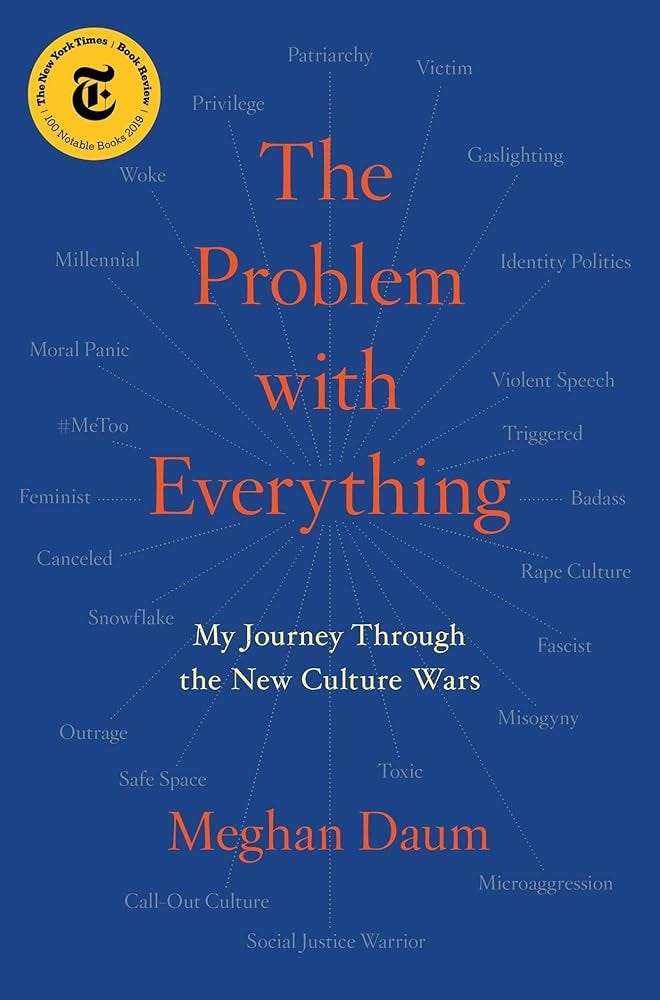
I also recommend The Problem With Everything: My Journey Through the New Culture Wars, by Meghan Daum (2019). Particularly, her chapters on “The Problem with Free Speech” and “The Problem with Humor.”
The Problem is an antecedent to Thomas Chatterton Williams’ Summer of Our Discontent, which tackles the culture wars from 2020 onward. Meghan tackles them up to 2019, from a dismayed liberal feminist perspective.
Dammit. Ok—one more recommendation, in the form of self-promotion.
Sam Kriss is perhaps the best young writer to tap the old vein of Gonzo journalism.
8 minutes comparing Kriss’ “Taylor Swift Does Not Exist” to Lester Bangs’ “Where Were You When Elvis Died?”:
More music, and literary criticism, by me. Eight minutes about one of the most incredible musical cultures in the world, and the people who risked their lives, and died, to preserve it—Cambodia.
This is a damn fine book review, IMHO, of The Scarlet Letter and The Crucible, comparing them (and their film versions) to modern scapegoating. Part III of a series that began with the article on Nancy Rommelmann’s cancelation. (3,800 words, 17 minute read.)
Ok, here’s the skinny—in the summer of 2023, shortly after I founded The Third Ear, I also found myself going through a divorce. And, doing a lot of sojourning and travel writing. Call it my Eat, Pray, Love phase. (But please, don’t actually call it that).
My early Tulsa coverage reflects this, as does my Voyage to Italy phase, which begins here. Much of what I talked about in “American Humor”—the grotesque, the origins of renaissance romance—I witnessed firsthand in Italy.
Beginning in Naples, with a visit to an ancient oracle, for advice about the future. Begin here, and go back through my archives if you want the rest of the story about my Road to the Cumaean Sybil. (1700 words, 5 minute read.)
This is 2000 words (9 minutes) on pop mythology—the modern version of myth and oral storytelling I wrote about in Italy. Garage bands, Tex-Mex, and their influence on punk.
Really, it’s a coded love song to a new girlfriend I was wooing at the time, who shares her name and Mexican heritage with the composer of “Little Red Riding Hood.” (And designed the cool Third Ear logos I use.)
This time, the woman I was wooing in words didn’t turn out to prefer the company of women.
The entire history of Mexico (you would think), in a 9,500 word (42 minute) review of Earl Shorris’ Life and Times of Mexico. Accompanied by my observations in Mexico City:
I later went to Spain, where I visited, researched, and wrote more about love songs, troubadours and romance poetry—some of what’s in “American Humor.” Here’s 1200 words (5 minutes), about the process of translating the lyrics of one love song into English.
More on Portland politics and culture, camp and kitsch, through the lens of local pro wrestling (long-form, 6,400 words, about 30 minutes):
If you haven’t heard the story of influential transhumanist Martine Rothblatt, the man who became a woman and, like Pygmalion, spent the last fifteen years building an artificial version of her wife so she can like live forever, this story (like Rothblatt, in my opinion) is insane. Read it here. (4,900 words, 22 minutes.)
The latest in my coverage of AI (see above). A discussion of Karen Hao’s Empire of AI with some nods to the film Eddington. (7,000 words, 30 minutes.)
I have no idea why these articles were the most popular.
Or if “Opened” rates are a better metric than “Views,” according to Substack data (I went with the former).
Perhaps I’ll do a list of my favorite articles next time (some of which happen to overlap with the “most popular”).
But my single best piece of investigative journalism, and writing, in my opinion (which happens to overlap with some of yours), is the one I launched The Third Ear with in March of 2023.
Cumulatively, it’s long-form—a five part series, totaling 15,000 words, averaging about 3,000 apiece. But I think it holds up—covering free speech, the insanity of elite academia, the problems of modern publishing, and the out-of-touchness of Jann Wenner, founder of Rolling Stone. With whom I spent an evening, in Berkeley.
Here’s the first installment. It’s only 800 words, a 3 minute read. If you like it, you can read the other four installments.
Thanks for three years, readers.
Selah.